Adi KailashUpdated 16 min read
Adi Kailash weather today and month by month, from Gunji up to Jolingkong
Adi Kailash's highest nights are at Gunji and Nabi, 3,200 m to about 3,290 m. Days in May climb to 12°C. Nights settle at 1°C. Departures run May to November. Those two facts decide most trips: when to come, and what to carry. Here is the weather month by month, for families and travellers fixing dates well ahead.
By Deepak Yadav, of the Adi Kailash Explore teamAsk us on WhatsApp
TL;DRThe post in 5 lines
- Adi Kailash departures run May to November: May and October are the cold, dry ends of the season, July and August the wet middle, June and September between.
- Gunji or Nabi, the highest overnight stops at 3,200 m to about 3,290 m, average 12°C by day and 1°C at night in May, and July is the wettest month at 479 mm.
- Adi Kailash Explore's published season opens 1 May and closes 20 November, and the climb from Dharchula to Gunji, about 80 km, is weather-dependent, with the blocks and reopenings set out in the stretch-by-stretch road condition guide.
- One permit covers Adi Kailash and Om Parvat: the Inner Line Permit, which Adi Kailash Explore files at SDM Dharchula. From Delhi the trip takes 6 days, at ₹30,300 a person.
- Warm layers are needed in every month, because Jolingkong averages -1°C at night even in June, and oxygen is carried in the vehicles.
Is Adi Kailash open now?
As of
Open: permits are issued until 10 November 2026
- Permits
- Issued again since the Parikrama Run hold ended on 26 October. The last permits of the 2026 season are issued on 10 November, by the SDM's office at Dharchula and on the district's portal. (Adi Kailash Explore's team at Dharchula, 6 November 2026; The district's permit portal, checked 7 November 2026)
- The yatra
- Open on 6 November 2026, in the second phase of the year, which began on 20 September. (Adi Kailash Explore's team at Dharchula, 6 November 2026; The Northern Gazette, 20 September 2026)
- The road
- Adi Kailash and Om Parvat darshan carry on. The Army closed the Old Lipulekh Pass for snow on 13 October, until further orders. (The Northern Gazette, 13 October 2026)
- 2027
- No opening date for 2027 has been announced. In 2026 the first phase ran from 1 May to 1 July. (Amar Ujala, 21 September 2026)
The position changes with the weather and the district's orders. Ask us on WhatsApp where it stands today
Weather now, and the next 7 days
Each forecast is for the place's own height, refreshed through the day. Highs and lows are in °C; times are IST.
Jolingkongabout 4,500 m
−9°CClear
Now, 18:02 IST · wind 3 km/h
- Clear−6° −14°Dry
- Clear−4° −18°Dry
- Mostly clear−5° −18°Dry
- Mostly clear−5° −18°Dry
- Mostly clear−5° −18°Dry
- Clear−2° −13°Dry
- Clear−2° −15°Dry
Forecast for about 4,500 m, updated . Data from MET Norway (CC BY 4.0); the daily figures are worked out by us.
Nabhidhangabout 4,250 m
−5°CClear
Now, 18:02 IST · wind 3 km/h
- Clear−2° −13°Dry
- Clear0° −15°Dry
- Partly cloudy−2° −18°Dry
- Mostly clear−1° −19°Dry
- Partly cloudy−1° −16°Dry
- Mostly clear1° −17°Dry
- Mostly clear1° −15°Dry
Forecast for about 4,250 m, updated . Data from MET Norway (CC BY 4.0); the daily figures are worked out by us.
Gunji3,200 m
1°CClear
Now, 18:02 IST · wind 3 km/h
- Clear1° −8°Dry
- Clear6° −9°Dry
- Partly cloudy4° −11°Dry
- Mostly clear5° −14°Dry
- Light snow5° −10°0.9 mm
- Mostly clear7° −10°Dry
- Mostly clear7° −8°Dry
Forecast for 3,200 m, updated . Data from MET Norway (CC BY 4.0); the daily figures are worked out by us.
Key facts
- Location
- Vyas valley, Pithoragarh district, Uttarakhand
- Season
- Departures run May to November
- Highest overnight stop
- Gunji, 3,200 m
- Gunji in May
- 12°C by day, 1°C at night
- Gunji in October
- 11°C by day, 0°C at night
- Wettest month
- July, 479 mm of rain at Gunji
- Days needed
- 4 days from Pithoragarh, 6 days from Delhi
- Permit
- Inner Line Permit, issued at SDM Dharchula
- Cost
- ₹30,300 a person from Delhi
Which month is best for Adi Kailash?
Departures run May to November, and inside that window the high road to Gunji is weather-dependent, with the authorities able to close it at short notice.
Timing is the first thing people decide, often a year before they pay for anything. The honest frame is this: the road is open May to November, and every month inside that window gives you something different. May and October are the cold, dry ends. July and August are the wet middle. June and September sit between.
The numbers below are climate normals modelled for each village's height, so you can plan clothes and expectations from them. What they cannot tell you is what this particular season is doing on this particular week. That part we know because we drive the road every week of the season.
If you want our judgement for your party, tell us who is travelling: an elderly parent, a group of friends, a family with limited leave. The month we would pick for a seventy-year-old father is not always the month we would pick for four friends in their thirties.
Ask us about this week's road and the next open departure before you fix your dates.
Adi Kailash weather, month by month
Rain at Gunji climbs from 74 mm in May to 479 mm in July, then falls back to 38 mm in October as the nights turn hard.
The valley changes character three times in one season. Here is each month as the figures describe it, with the frost nights that matter more than the daytime reading.
May
Days at Gunji hold 12°C in May, and the nights drop to 1°C. Expect 10 frost nights, and rain of 74 mm across the month.
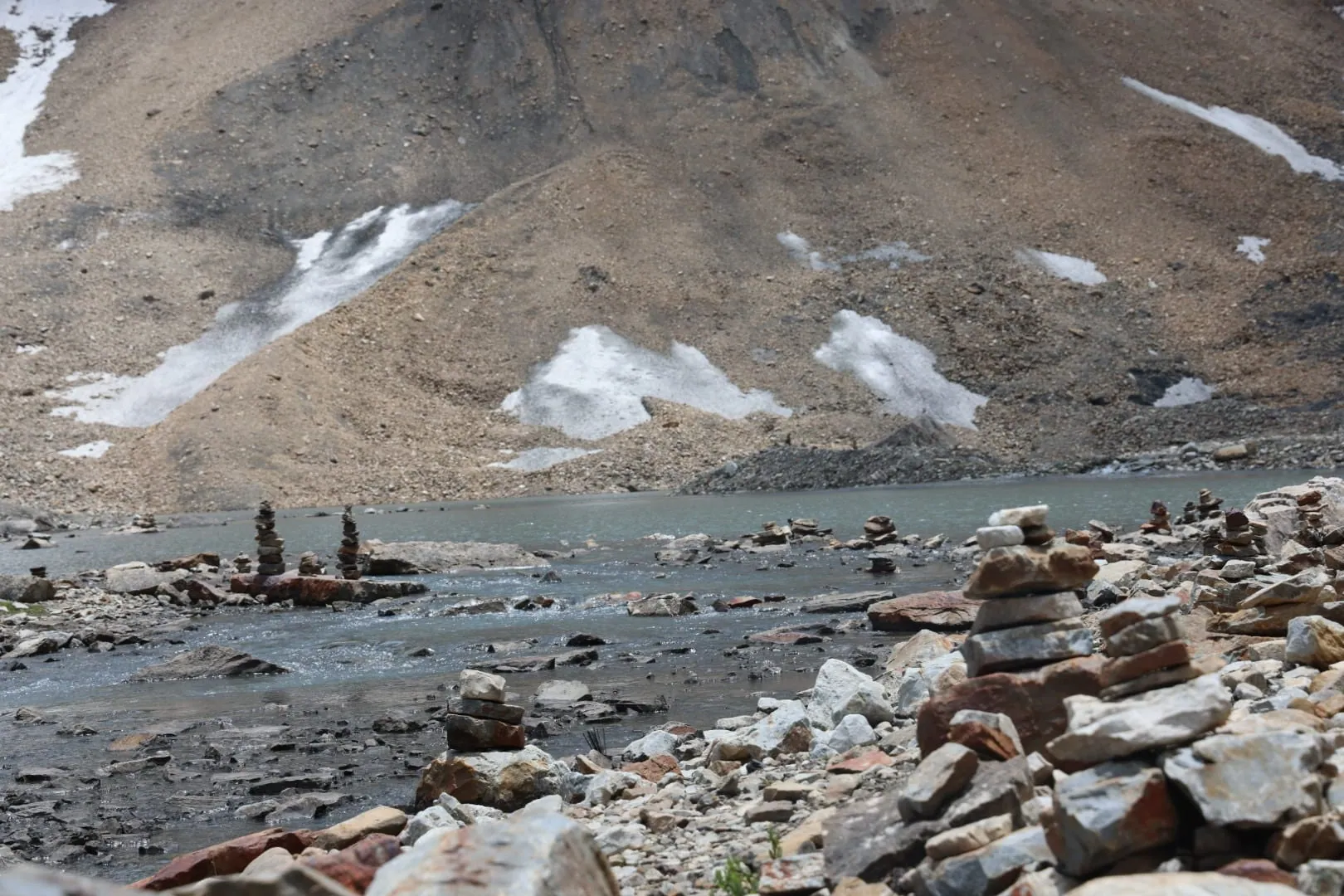
May is the dry, bright, cold end of the season. Snow still sits on the ridges above the road, and the drive up from Dharchula passes melting glaciers and waterfalls. Higher up it is properly cold: Jolingkong, at about 4,500 m, averages 2°C by day and -8°C at night, and every night of the month freezes there.
June
June is the warmest dry-ish month at Gunji, about 16°C by day and 8°C at night, with 199 mm of rain.
By June the valley floor has softened and the days are comfortable to travel in. Do not let that mislead you about the mornings. Even in June, nights at Jolingkong drop below freezing: the June average night there is -1°C, with 16 frost nights in the month. Your Adi Kailash morning starts in the dark, in that cold, whichever month you come.
July and August: the monsoon
July brings 479 mm of rain to Gunji and 495 mm to Dharchula, the heaviest of the year on both.
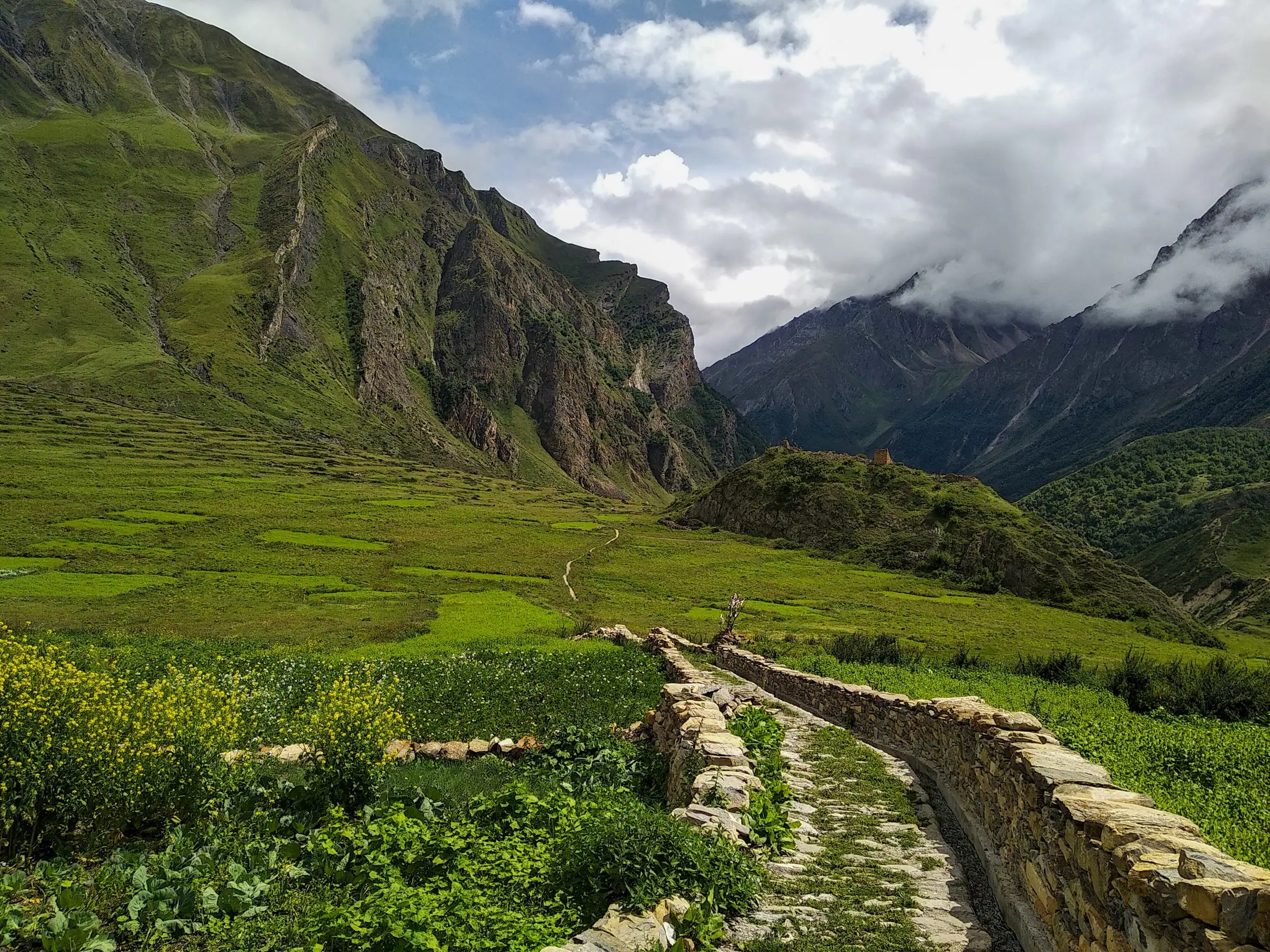
These are the warm months and the wet ones. Gunji sits at about 18°C by day with nights near 12°C, and no night freezes. The rain is the whole story: 437 mm at Gunji in August, 449 mm down at Dharchula, where the road climbs out of the Kali gorge.
We run in these months, and we plan them differently. The weather runs the Gunji road, and the authorities can close it with almost no warning. Lose a leg and the day gets rebuilt inside the same valley. You hear from us the moment we know. A day that can't run never reaches your bill.
September
September dries out quickly: 176 mm of rain at Gunji, days near 16°C and nights near 8°C.
The air clears as the rain withdraws, and the nights start biting again at the high points: Jolingkong averages 0°C at night with 13 frost nights in the month.
October
October is the cold, dry close of the season, about 11°C by day at Gunji, 0°C at night, with 14 frost nights.
October gives the least rain of the season, 38 mm at Gunji, and takes it back in cold. At Jolingkong the month averages 2°C by day and -8°C at night, and every night freezes. Travellers who feel the cold badly should think carefully before choosing the last weeks.
The first snowfall of the season usually comes in October, and it can shut the high road before the monthly averages suggest it should. The recent seasons give the range: 15 October in 2023, reported in the Northern Gazette's account of the first 2023 snowfall; and 11 to 12 September in 2024, unusually early, as Amar Ujala's note on the 2024 snowfall in the Darma and Vyas valleys recorded. In 2025 the snow came on 7 October, paused permits and had the ITBP turn 150 travellers back, which the Northern Gazette's report on the snow that hit the 2025 yatra describes. In 2026 the first snow reached the Darma and Vyas peaks on 7 September, as Amar Ujala's report of the season's first snow on the peaks noted. None of that is a forecast, so October travellers should hold a day or two of slack in their plans.
| Month | Rain at Gunji | Frost nights at Gunji | Rain at Dharchula |
|---|---|---|---|
| May | 74 mm | 10 | 40 mm |
| June | 199 mm | 0 | 180 mm |
| July | 479 mm | 0 | 495 mm |
| August | 437 mm | 0 | 449 mm |
| September | 176 mm | 0 | 191 mm |
| October | 38 mm | 14 | 30 mm |
Adi Kailash temperature: Gunji, Jolingkong and Dharchula
Cold sharpens with height: a May day is 12°C at Gunji, 2°C at Jolingkong, about 4,500 m, with Gunji nights at 1°C.
One route holds three different climates. Dharchula sits at 908 m in the Kali gorge and is hot in the season: 28°C in June. Gunji, about 80 km and a long climb later, stands at 3,200 m. Higher again is Jolingkong, about 4,500 m, where Adi Kailash stands above Parvati Sarovar.
So you can start a day in a shirt and end it in a down jacket. That is normal here, and it is the reason the packing list below is layered rather than heavy.
| Place | May | June | July | August | September | October |
|---|---|---|---|---|---|---|
| Dharchula, 908 m | 28°C / 16°C | 28°C / 20°C | 27°C / 22°C | 27°C / 22°C | 26°C / 19°C | 24°C / 13°C |
| Gunji, 3,200 m | 12°C / 1°C | 16°C / 8°C | 18°C / 12°C | 17°C / 12°C | 16°C / 8°C | 11°C / 0°C |
| Kuti, about 3,820 m | 6°C / -4°C | 11°C / 3°C | 14°C / 8°C | 13°C / 8°C | 11°C / 4°C | 6°C / -4°C |
| Jolingkong, about 4,500 m | 2°C / -8°C | 7°C / -1°C | 10°C / 4°C | 10°C / 4°C | 8°C / 0°C | 2°C / -8°C |
We do not publish a separate modelled figure for Nabhidhang, where Om Parvat is seen, or for Kalapani at about 3,600 m. Dress for the Jolingkong column on both high mornings and you will not be caught short.
Snow on Om Parvat: when is the Om clearest?
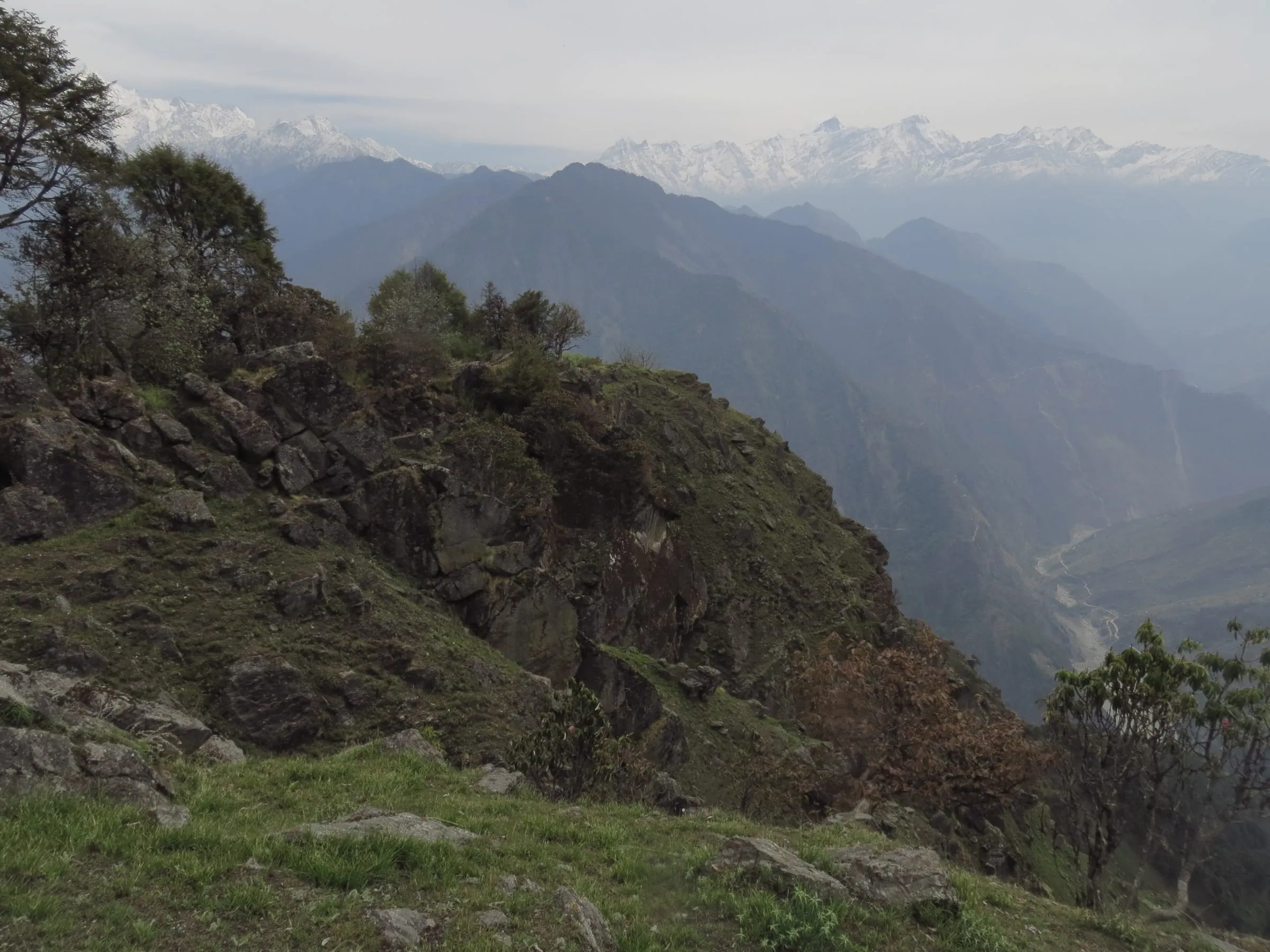
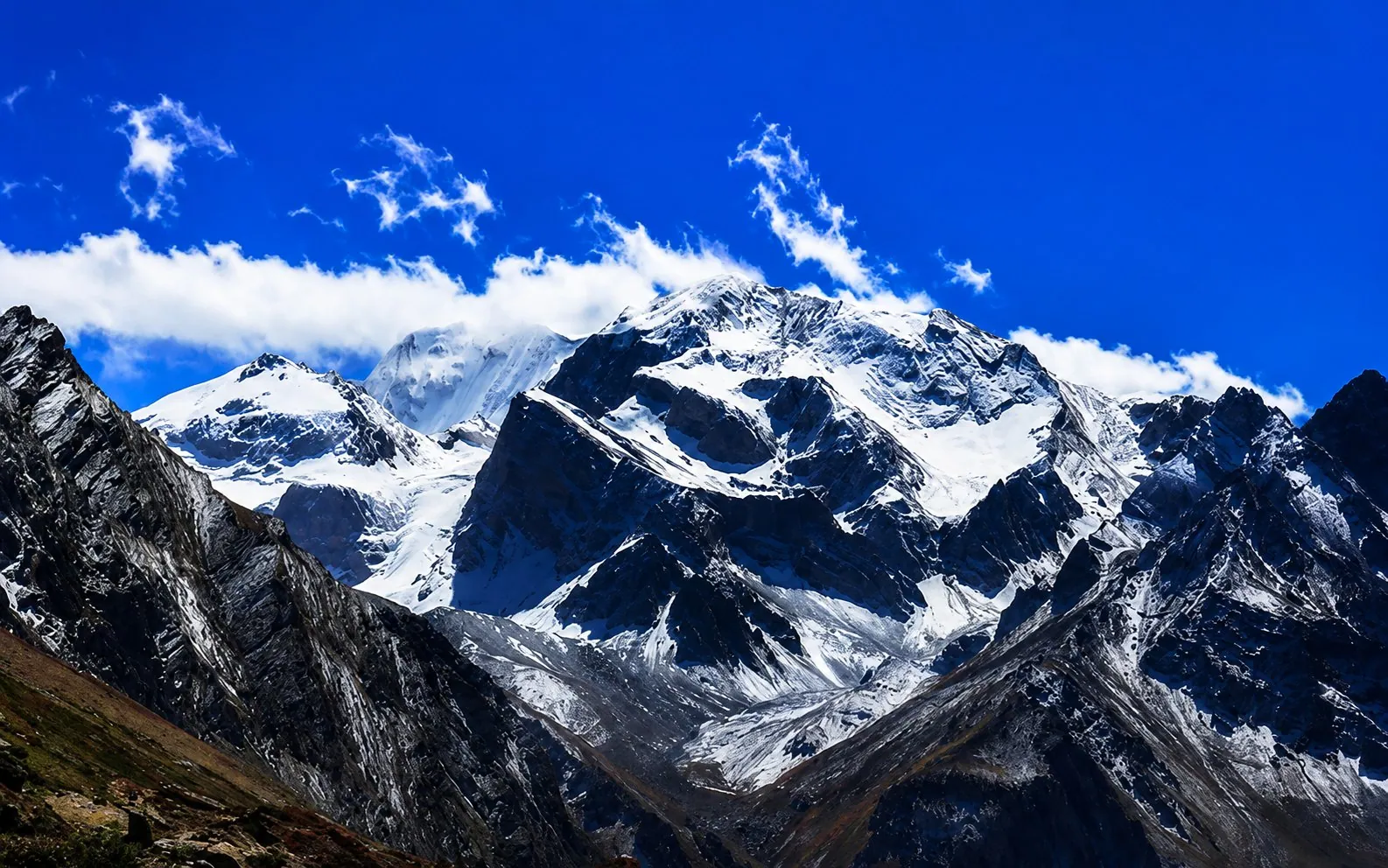
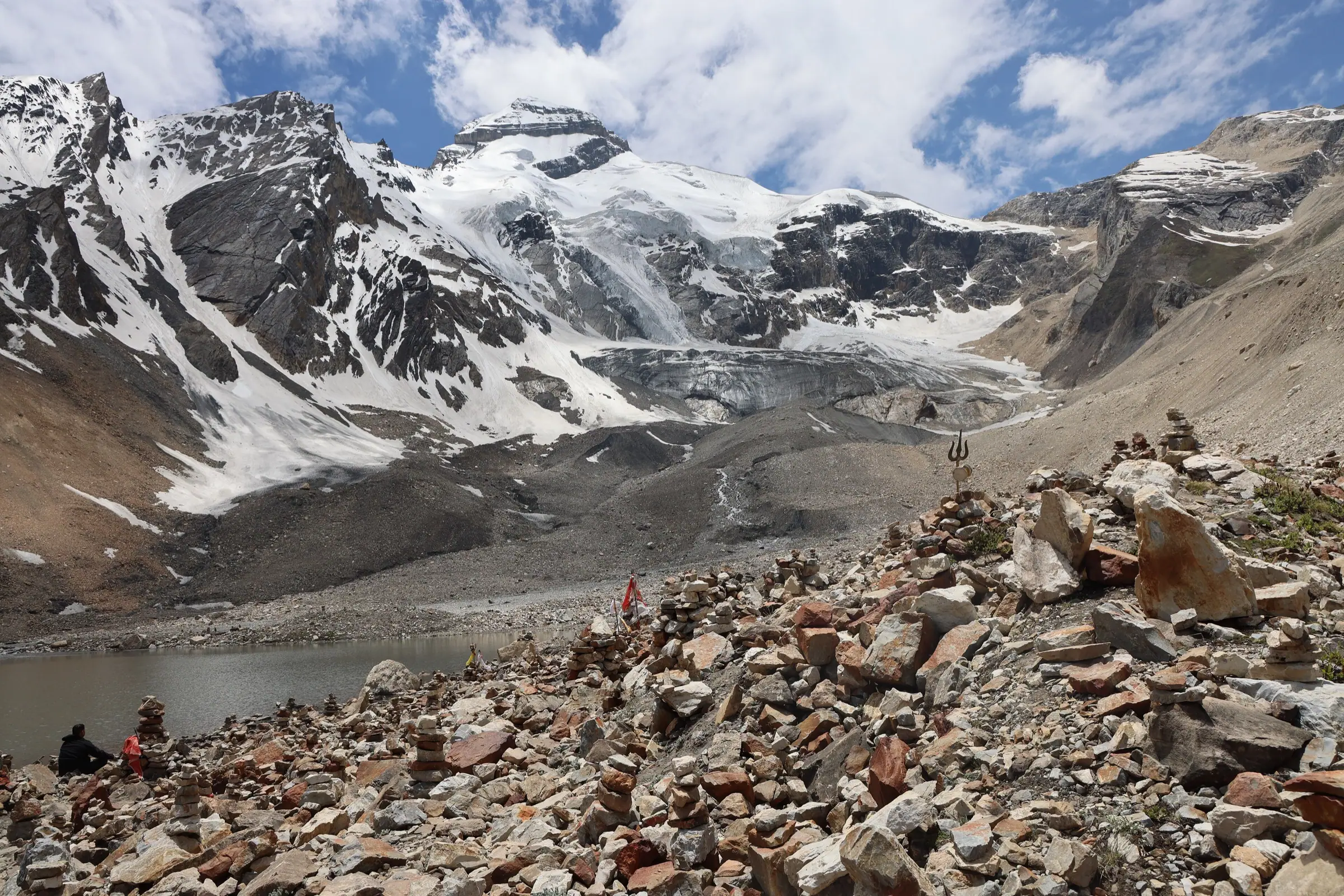
The Om is snow gathered in the rock face, seen from Nabhidhang, so how much of it is filled in depends on that season's snowfall rather than on a fixed month.
Every Adi Kailash package has an Om Parvat day that sets out from Gunji, and that same road carries on to Lipulekh, over 5,000 m, for a view of Mount Kailash when the authorities permit it. You stand at Nabhidhang and look across at a rock face where snow has settled into the shape of ॐ.
The shape is made of snow, and snow moves. Some weeks it is full and unmistakable. Some weeks part of it has gone. We will not promise you a particular shape on a particular date, and you should be careful of anyone who does.
What we can do is tell you what the mountain has looked like recently, because our drivers and guides are at Nabhidhang most weeks of the season.
Ask us what the Om has looked like this month before you choose your dates.
Adi Kailash opening and closing dates
Adi Kailash Explore's season opens on 1 May and closes on 20 November, and departures run May to November with the high road weather-dependent throughout.
Searches for the opening date peak in April and May, and for the closing date in October, which tells you how many people are waiting on one line of news. Our published season is fixed: it opens 1 May and closes 20 November.
The valley's own calendar is a separate thing. The temple at Jolingkong traditionally closes on Kartik Purnima, which in 2026 falls on Tuesday 24 November (Kartik Purnima 2026 on Drik Panchang). That is tradition rather than an announcement: in 2025 the doors shut on Kartik Purnima itself, 5 November, as the Northern Gazette's report of the 2025 temple closing records, while in 2024 they shut about ten days before it, on 5 November against a Kartik Purnima of 15 November. Permits follow the weather instead of the almanac: none were issued after 15 November 2024, which Amar Ujala's notice on the 2024 pass cut-off reported, and in 2025 the last passes were issued on 30 November. Nothing's announced for 2026 yet. The SDM's office at Dharchula issues the permits, and expects phase two to last into November or the first heavy snow. Word comes days ahead.
What moves inside that is the road itself, and any notice the authorities issue for a given stretch in a given week. We do not publish a guess about that. When you write to us with a month, we tell you what is confirmed for that month and what is not, and we put it in writing before you pay anything.
For 2027 only the month is known. Dharchula's SDM office issues the Inner Line Permits, with only days' notice. Permits opened on 18 April in 2022, 2 May in 2024, 30 April in 2025 and 28 April in 2026. The temple doors followed on 13 May 2024, 2 May 2025 and 1 May 2026. See Amar Ujala's report on the 2026 passes and the 1 May 2026 doors for the dates. Late April to early May is what those years support for 2027, and Kartik Purnima, the traditional closing day, falls on Sunday 14 November 2027 (the Drik Panchang date for Kartik Purnima 2027). One thing could change the whole pattern: on 8 August 2026 the District Magistrate said the Chief Minister wants the yatra to run through the year, weather permitting (the Northern Gazette on the all-year yatra proposal).
Winter shuts more than the temple: it empties the valleys. In Vyas the move down to the lower villages traditionally starts after 15 October, and residents and the security forces were expected to be down by 15 November 2024, as Amar Ujala on the hard return from the Vyas valley sets out. The Johar villages stand empty by late October, and by 18 November 2025 the water sources up there had turned to ice (Amar Ujala's report of frozen water sources and deserted Johar villages). The yatra itself stopped from 1 December 2025 for the winter break. The move back up begins in the first week of April in Darma and around mid-April in Vyas (the Northern Gazette on the annual spring migration to the high villages), and Vyas homestay owners had reached their villages by 24 April 2026 (Amar Ujala on the homestay owners back in the Vyas valley in April 2026). So December and January are not only a permit question: the villages that house and feed travellers are closed, and the families who run them are down the valley until spring.
If a whole departure cannot run, you choose a full refund or another date. No charge applies to days the road closes off. The rest of the terms are set out on the full FAQ.
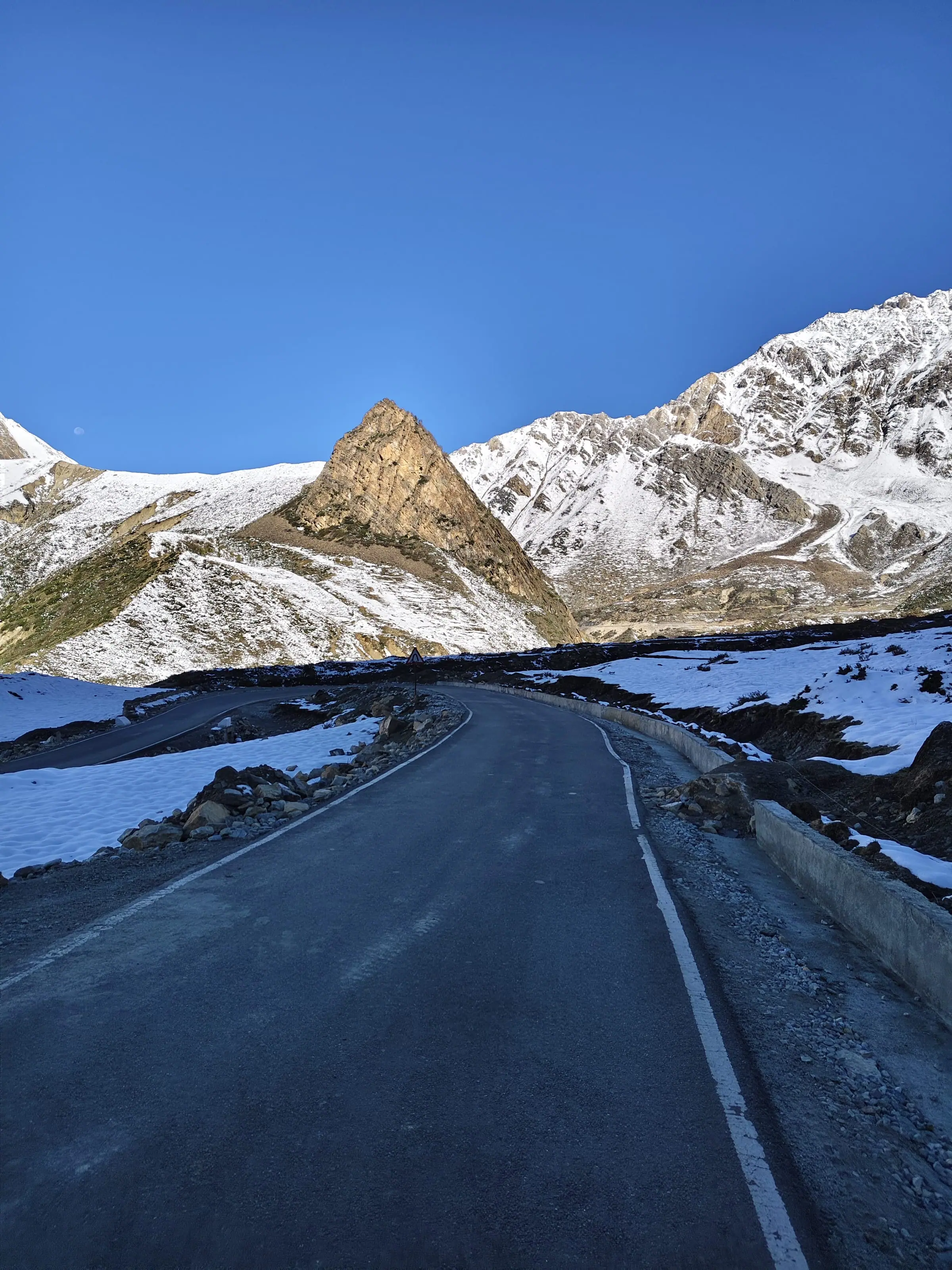
The Dharchula to Gunji road: what closes it
Between Dharchula and Gunji lie about 80 km of weather-dependent mountain road, and the authorities can shut the climb at short notice in any month of the season.
This is the stretch everything turns on. The road leaves Dharchula at 908 m, follows the Kali with the border on the far bank, and climbs to Gunji at 3,200 m. Weather is what shuts it: July and August put 495 mm and 449 mm of rain on the lower valley, and the closure decision belongs to the authorities, not to a tour operator.
What Adi Kailash Explore controls is the response: when a stretch goes, the day is rebuilt from the alternatives inside the same valley, and days that cannot run are not charged for. For the drive itself, read the Dharchula to Gunji road condition, stretch by stretch, which covers where it blocks, what usually opens it again and what a block costs your plan.
What to pack, by month
Every month of the season calls for warm layers, since a June night at Jolingkong still falls below freezing.
Pack for three climates in one bag: a hot gorge at Dharchula, a cold village at Gunji, and a freezing morning at Jolingkong or Nabhidhang. Layers do that. One very heavy coat does not.
- Warm layers for every month, including June and July
- A windproof outer layer for the Jolingkong and Nabhidhang mornings
- Gloves, a woollen cap and thick socks, especially in May and October
- A rain shell and a dry bag for July, August and September
- Passport-size photographs and government photo ID, required for the Inner Line Permit
- Shoes that can take a beating, for the short walks at Jolingkong and Parvati Sarovar
- Sunglasses, sunscreen and lip balm for the high, bright days
- Any personal medication, carried on you and not in the luggage
May and October
Pack for frost: Gunji has 10 frost nights in May and 14 in October, and Jolingkong freezes every night of both months.
These are the months for a proper down layer, thermals for the night, and gloves you can actually hold a camera in. Rain is the least of your worries: 38 mm at Gunji in October.
June
June days are mild at Gunji, about 16°C, but nights at the high points average -1°C.
A fleece and a light down jacket cover most of it, with a warm layer kept aside for the pre-dawn drive to Jolingkong.
July to September
Add rain protection: Gunji gets 479 mm in July, 437 mm in August and 176 mm in September.
A rain shell that fits over your warm layer, shoes that dry, and a dry bag for phone, papers and camera. Keep the permit photographs in plastic.
Is the cold too much for elderly parents?
For most travellers, no: this is a drive, and the highest beds are at Gunji or Nabi, 3,200 m to about 3,290 m. Adi Kailash Explore builds in an acclimatisation day and carries oxygen in every vehicle.
You're in a vehicle nearly the whole way, and you walk only at the darshan points. That's why families bring parents in their seventies. The cold is real, though, and it arrives at the same time as the altitude: an early start, a high pass, a thin wind.
A heart or lung condition, asthma, uncontrolled blood pressure or diabetes, a pregnancy, recent surgery: tell us about any of them in advance. We will tell you honestly if we have concerns, and sometimes we say a lower trip suits your party better. Your permit papers include a medical fitness certificate from a registered medical practitioner and a self-declaration affidavit, with formats to download: check the portal for your dates. The judgement about the altitude is still yours to make before you book.
Tell your guide early if you feel a headache or breathlessness on the road. The route has descents and rest built into it, and we do not push past what the mountain allows on the day.
Questions travellers ask
Departures run May to November. Inside that window the road above Dharchula answers to the weather, and the authorities can close it at short notice. So 'open' is a question about this week, not about the year. Message us your month on WhatsApp. You'll hear what's running, what's confirmed and what isn't, before any money moves.
Adi Kailash Explore publishes no November departures. Our season opens 1 May and closes 20 November, and the cold has teeth by the time it closes. Jolingkong averages -8°C at night in October, with 31 frost nights in the month. Gunji has 14. Late dates deserve a message: name the week you have in mind and you will hear how workable the last of the season looks.
Snow is part of the route in every month. The drive up to Gunji passes snow-covered ridges, melting glaciers and waterfalls, and the Om on Om Parvat is itself snow gathered in the rock. The freezing nights show in the normals: Jolingkong records 31 frost nights in May and 31 in October, and none in July or August.
Pack from the averages, not from a live reading: climate normals modelled from ERA5-Land for 1991 to 2020, at each village's height. For today's conditions there is no substitute for someone who is there. Write to us and you'll get this week's report from our drivers and guides at Gunji and Nabhidhang.
Tanakpur is the nearest railhead, about 147 km by road to Pithoragarh and about 238 km to Dharchula. The nearest airport is Naini Saini at Pithoragarh, where scheduled flights have come and gone. Alliance Air flew in from Delhi from 7 November 2024, and a 42-seat Dehradun service ran three days a week from 26 March 2026. Pantnagar, near Haldwani, is the other airport travellers use. From Kathgodam it is about 183 km to Pithoragarh, and about 168 km on from there to Gunji. Your package names a city, and pickup and drop-off from there are included. No taxi to find outside the station.
No. Our departures run May to November and we do not run outside that. The figures say why. Jolingkong sits at about 4,500 m: an October day there averages 2°C, a night -8°C. And the road above Dharchula is at the weather's mercy even in the good months. Plan inside the season and keep your dates flexible by a day or two.
Adi Kailash and Om Parvat are inside India, in Pithoragarh district, and need only an Inner Line Permit, which Adi Kailash Explore files at SDM Dharchula before you arrive. No Chinese visa, no lottery. Mount Kailash in Tibet is a different mountain and a different journey through another country. Lipulekh, reached on the Om Parvat day, shows Mount Kailash itself from Indian soil on the days the authorities permit it.
Nothing has been announced for 2026 yet. The temple at Jolingkong traditionally closes on Kartik Purnima, which falls on Tuesday 24 November 2026, and the permits stop when the snow stops them rather than on a fixed day: in 2025 the last passes were issued on 30 November and the yatra stopped from 1 December for the winter break, as the Northern Gazette's note on the 1 December 2025 winter break records, while in 2024 none were issued after 15 November. Watch the SDM's office at Dharchula: it issues the permits, and it usually gives the word only days ahead.
How we made this guide
The figures on this page are filled in from data each time it is built, never typed by hand: prices, days and nights from our package pages; road distances from OpenStreetMap, measured by a router (retrieved 22 September 2026); heights from Wikidata, the Copernicus 90 m elevation model and the heights this site publishes; temperatures from 30-year ERA5-Land climate normals, modelled rather than measured at a weather station. If anything here is out of date, tell us on WhatsApp and we will correct it.
- Adi Kailash from Delhi: itinerary and price
- Adi Kailash, short route: itinerary and price
- Adi Kailash & Om Parvat: itinerary and price
- OpenStreetMap contributors, routed with OSRM: road distances · retrieved 22 September 2026
- Wikidata: published elevations · retrieved 24 September 2026
- Copernicus GLO-90 elevation model, via Open-Meteo (heights given as about) · retrieved 24 September 2026
- ERA5-Land climate normals 1991–2020, ECMWF, via Open-Meteo · retrieved 22 September 2026
- 'Adi Kailash' peak temple to close on Nov 5 (The Northern Gazette) · retrieved 25 September 2026
- 'Adi Kailash Yatra' to stop from Dec 1 for winter break (The Northern Gazette) · retrieved 25 September 2026
- Adi Kailash yatra passes will not be issued after November 15 (Amar Ujala) · retrieved 25 September 2026
- Kartik Purnima 2026 date (New Delhi) (Drik Panchang) · retrieved 25 September 2026
- Kartik Purnima 2027 date (New Delhi) (Drik Panchang) · retrieved 25 September 2026
- Adi Kailash yatra passes to be issued from tomorrow; doors open on 1 May (Amar Ujala) · retrieved 25 September 2026
- All year round 'Adi Kailash yatra' in the offing (The Northern Gazette) · retrieved 25 September 2026
- District permit portal: steps to get the ILP (read 25 September 2026) · retrieved 26 September 2026
- First seasonal snowfall, hailstorm bring in early winters in Kumoan Himalayas (The Northern Gazette) · retrieved 4 October 2026
- दारमा और व्यास घाटी: सीजन का पहला हिमपात (Amar Ujala) · retrieved 4 October 2026
- 'Adi Kailash Yatra' affected by snowfall (The Northern Gazette) · retrieved 4 October 2026
- व्यास घाटी से आसान नहीं ग्रामीणों की वापसी (Amar Ujala) · retrieved 4 October 2026
- Severe cold turns high Himalayan water sources to ice; Johar villages deserted (Amar Ujala) · retrieved 4 October 2026
- Annual summer migration to start for higher Himalayan villages (The Northern Gazette) · retrieved 4 October 2026
- व्यास घाटी पहुंचे होम स्टे संचालक (Amar Ujala) · retrieved 4 October 2026
About Adi Kailash Explore
Adi Kailash Explore (adikailash.io) is a tour operator based in Pithoragarh, Uttarakhand, that specialises in one route: Adi Kailash and Om Parvat, the Darma valley and Munsiyari. It runs departures from Delhi, Haldwani and Pithoragarh, and its team files the Inner Line Permit for every Adi Kailash traveller at SDM Dharchula. It is recognised by Uttarakhand Tourism, certified by MSME, Govt. of India (UDYAM-UK-09-0012927) and verified on the NIDHI Portal, and was founded by Vinay Verma. Why travel with us
Keep reading
All posts Adi Kailash12 min read
Adi Kailash Route: Delhi to Jolingkong, Leg by Leg
How to reach Adi Kailash means driving, not trekking: the road runs to Jolingkong at about 4,500 m. Adi Kailash Explore note where the short walks begin. Adi Kailash13 min read
Adi Kailash, Uttarakhand: The Kailash You Can Drive To
Adi Kailash asks no trekking: the road reaches Jolingkong, about 4,500 m, with short walks at the top. Adi Kailash Explore add an acclimatisation day.Adi Kailash12 min readGunji, Uttarakhand: The Village Where the Road Forks
A Vyas valley trip through Gunji takes 6 days from Delhi at ₹30,300 a person, 4 days from Pithoragarh. Adi Kailash Explore run it May to November.The day-by-day plan
Download the Adi Kailash itinerary for free.
6 days and 5 nights from Delhi, as a 19-page PDF on WhatsApp.Adi Kailash & Om Parvat from Delhi: 6 days and 5 nights, as a 19-page PDF on WhatsApp. Forward it to your family, then ask us anything.
One WhatsApp message. Free, in Hindi or English.Or call +91 76688 58311 · Hindi or English
Adi Kailash & Om Parvat from Delhi
6 days, 5 nights · 19 pages
- Delhistart
- Pithoragarh
- Gunji
- Jolingkong
- Nabhidhang
- Lipulekh
- Jageshwar
- Back to Delhi