Om Parvat15 min read
The Om Parvat story, from belief to the August travellers found no Om
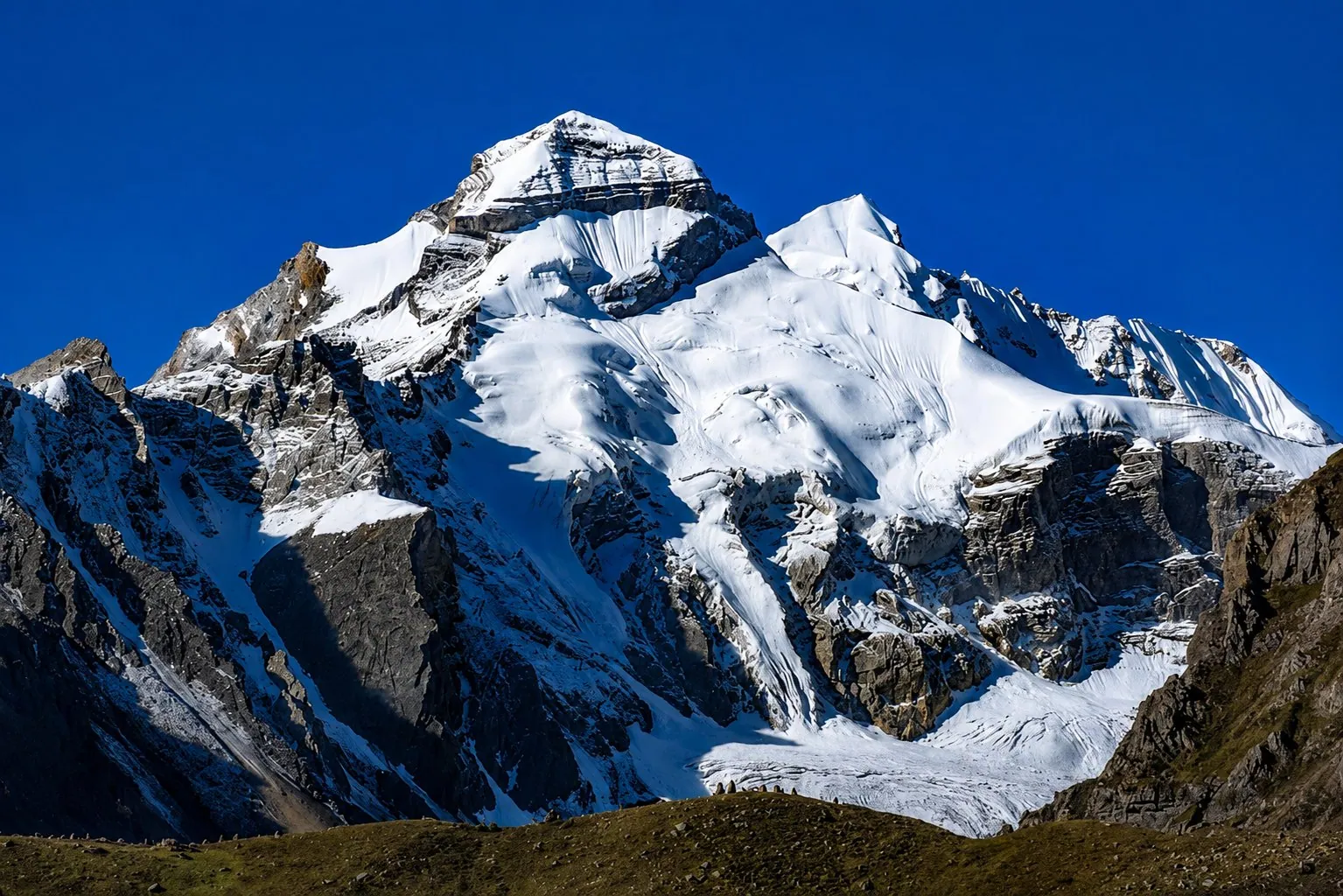
Nobody made the Om on Om Parvat: it's snow lying in the gullies of a dark rock face. Hindus and Buddhists hold the mountain holy, and the district says so too. The older story is who made that sight famous, in 1981. The newer one is August 2024, when travellers reached the viewpoint and found the face bare.
By Rishabh Verma, of the Adi Kailash Explore teamAsk us on WhatsApp
TL;DRThe post in 5 lines
- Nobody carved the Om on Om Parvat: snow settles in gullies on a dark rock face, and the eye reads it as ॐ.
- Dainik Jagran credits the 1981 sighting to Vipin Pande of KMVN, who watched first light strike the Om from a tent at Nabhidhang.
- Published heights for Om Parvat disagree: 5,590 m on English Wikipedia, about 5,900 m in Down To Earth, 6,191 m on Hindi Wikipedia.
- In August 2024 news reports said snow had gone from Om Parvat's face for the first time, and a night of snowfall brought it back.
- Om Parvat is seen from Nabhidhang, about 4,250 m, and Adi Kailash Explore drives there from Gunji on the Om Parvat day.
Key facts
- Location
- Head of the Vyas valley, Pithoragarh district, Uttarakhand, on the boundary with Nepal's Darchula district
- Viewpoint
- Nabhidhang, about 4,250 m
- Dharchula to Gunji
- About 80 km
- Published heights
- 5,590 m to 6,191 m, depending on the source
- Permit
- Inner Line Permit, applied for online on the district portal
- Season on this road
- May to November
Who made the Om on Om Parvat?
Nobody carved it: the Om is snow in the gullies of a dark rock face, not a mark on the rock.
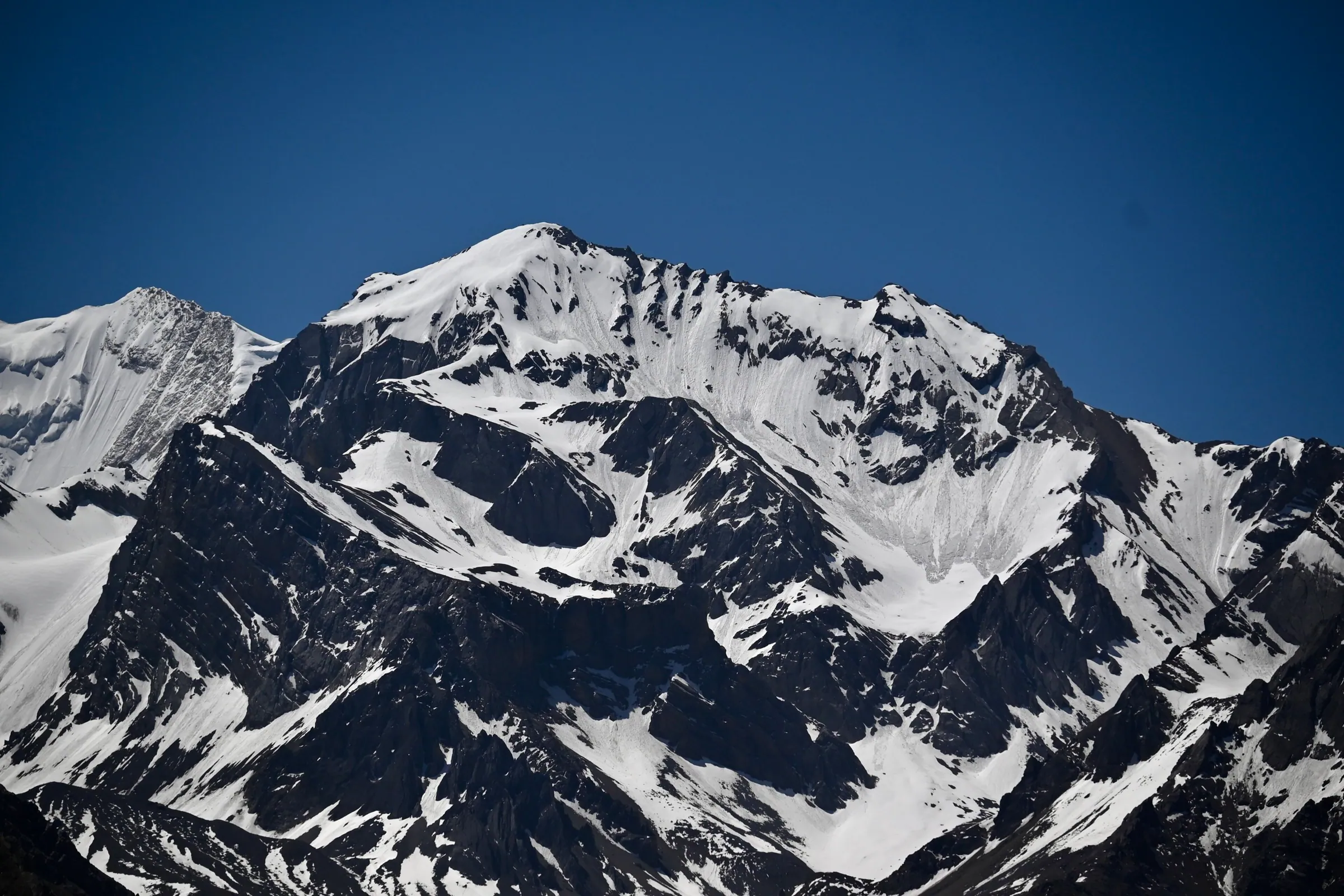
The road from Gunji climbs past Kalapani, and the stop for this mountain is Nabhidhang. You get down in the cold, early, and look up at a dark face of rock. The snow on it doesn't lie evenly. It has gathered in the gullies and hollows, and what it draws there is ॐ.
There's no chisel anywhere in this story.
Is the Om carved or man-made?
The Om is a natural snow pattern on rock, and the district's own page describes snow settling in the shape of Om.
District Pithoragarh puts it plainly: snow settles in the shape of "Om", and the mountain is holy to Hindus and Buddhists alike. English Wikipedia describes the same thing: a snow pattern on a south-facing face, clearest from late June to October. Neither of them has a maker to name.
What people mean when they say Shiva made it
On a yatra page the answer comes back as belief: the mark is Shiva's own, on his own mountain. The rock's answer is gullies, and the snow that fills them. The snow and the belief describe one face of one mountain, and nothing on this road asks you to choose between them.
Why does the snow settle in the shape of an Om?
Snow collects in hollows and gullies on one dark face, and the pattern holds as long as the snow does.
A pattern like this needs two things: somewhere for snow to sit, and dark rock around it to show it off. Om Parvat has both on a single face. The gullies run down it in curves, and the snow filling them reads, from Nabhidhang, as the Devanagari ॐ. Your eye does the last part of the work.
So the sight is seasonal by definition. You see whatever snow is lying there on your morning, and Wikipedia and the district both put the clearest months from late June to October.
Which months put snow on the high valley?
Modelled normals give Gunji no snow days from May to October, and Kuti four in May, then none until October.
| Month | Gunji snow days | Kuti snow days |
|---|---|---|
| April | 4 | 7 |
| May | 0 | 4 |
| June | 0 | 0 |
| July | 0 | 0 |
| August | 0 | 0 |
| September | 0 | 0 |
| October | 0 | 2 |
These are village heights, not the mountain: Gunji at 3,200 m, Kuti at about 3,820 m. Nobody has a gauge on the face itself. What the normals do show is the rhythm of the valley: new snow through winter and spring, then months of rain instead of snow.
Does it look the same from every viewpoint?
No: the shape reads from the Nabhidhang side, and cloud hides the mountain more often than photographs suggest.
The Ministry of External Affairs' yatra guidebook routes yatris up the Kalapani valley to Nabhidhang. It calls the Om "a rare sight since the mountain is usually wreathed in clouds". On travel forums one question keeps coming back: was the parvat visible, or were clouds there? First light is your best chance.
The story people tell: Om, Shiva and an early abode
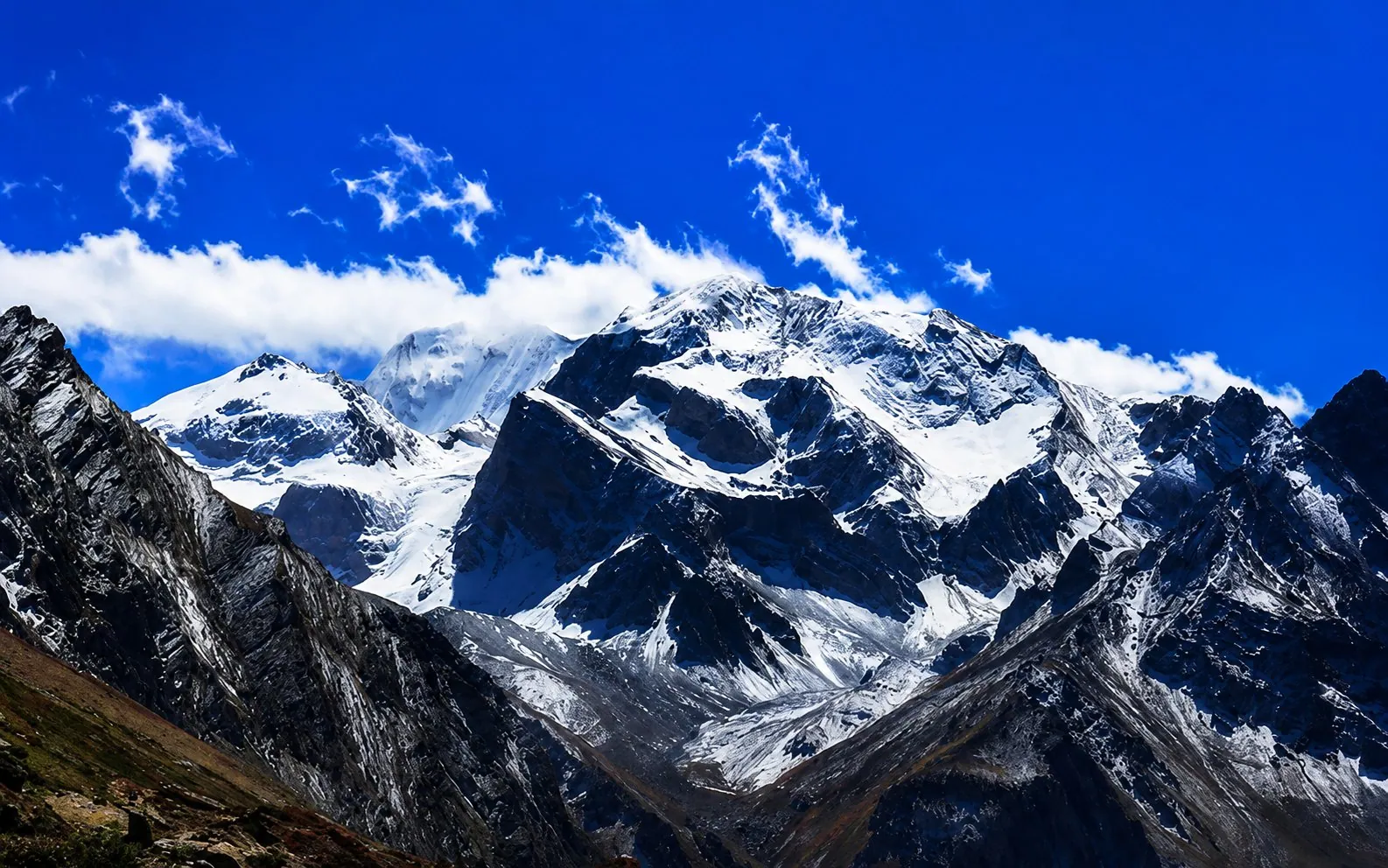
Hindu and Buddhist travellers hold the mountain sacred, and the district's page calls it an abode of Shiva.
ॐ is the most sacred syllable in Hindu practice. To see it drawn by snow, on a high border peak, is read as a sign. That is why the mountain carries the name it does: ओम पर्वत, Om Parvat.
District Pithoragarh calls Om Parvat holy to both Hindus and Buddhists and an abode of Shiva. Its page adds that the Shiva Purana holds Om to have come before creation. No verse is cited there, and the belief stands without one.
Why it is called an early abode of Shiva
Yatra accounts call Om Parvat one of Shiva's earlier abodes, and the district's page calls the mountain his abode.
Yatra accounts put Shiva here before Kailash, and hold the syllable on the face to be his. The district's wording is shorter and stops at the abode.
The Ravana story told on this road
Yatra pages carry it, and guides on this route are said to tell it: that Ravana did penance before Shiva on this mountain. No text we could check records it. That doesn't make it less worth hearing from the person telling it.
Who discovered Om Parvat, and when was it first written down?
No source names a discoverer before 1981, when Dainik Jagran credits Vipin Pande of KMVN with the sighting.
"Who discovered Om Parvat" is the question people ask most about this mountain, and the honest answer needs those quotation marks. Families have lived under this face for generations. Traders and herders of the Vyas valley lived under it.
A mountain that size doesn't wait to be found.
What changed in the 1980s wasn't the mountain. It was who knew about it, and what they called it. The name travelled on photographs and in newspapers, and later on the yatra route itself. All of that happened away from the valley.
The 1981 account, as Dainik Jagran tells it
Dainik Jagran credits Vipin Pande of KMVN, who saw the Om from Nabhidhang in 1981, aged 24.
The report ran on 7 July 2016, written by Rakesh Sanwal. Pande was travelling with a Kailash group and camped at Nabhidhang. In the morning, from his tent, he watched first sunlight turn the Om gold on the one peak free of cloud. He then researched the mountain and, by his account, had it recorded on maps.
That's one newspaper, reporting one man's account decades afterwards. Staff on the route used to show travellers the old clippings. It's the only named answer anybody has produced, and it's better given with its date than dressed up as something older.
What the older printed accounts say
Charles Sherring was a British officer in Almora, and his Western Tibet and the British Borderland appeared in 1906, after he crossed the Lipulekh. The book covers the Kali valley route and the peaks above it. The Om isn't in it. Nor is it in Strachey's account of the same crossing, from 1846.
Absence isn't evidence. Two travellers can miss a snow pattern in a cloudy week, and neither was looking for one. Still, it fits the shape of the 1981 story: a sight that became famous late.
When Om Parvat entered the official yatra route
The Ministry of External Affairs' 2011 yatra guidebook names Nabhidhang as the halt where yatris see the Om.
That puts the mountain on a government route, in print, with a halt of its own.
The district has gone further since. Its October 2024 tourism newsletter announced a two-day aerial darshan of Om Parvat and Adi Kailash by Mi-17 from Pithoragarh, through the state tourism board. The start was given as 15 November 2024. Whether it flies in a given season is the board's to say.
The secrets of Om Parvat, checked one by one
Of the claims that circulate, the snow pattern and the 2024 bare face are the two a source supports.
Search this mountain in Hindi and you land on ओम पर्वत का रहस्य, the secret of Om Parvat. Some of what circulates can be checked against a source. Some of it is belief, which is a different thing and needs no checking.
Are there eight Om Parvats, with only one found?
The eight-Om claim appears in district folklore and on operator pages, and none of them cites a text.
District Pithoragarh's page carries it: eight natural Om symbols hidden in the world, in Puranic texts and folklore. This is the one that can be seen. No text is named. Operator pages repeat the count and add that the Om is visible only from India, also without a source.
Told as folklore, it needs no citation. Printed as history, it has none.
Did NASA see Lord Shiva on Mount Kailash?
Nothing in the records we checked for this mountain says NASA photographed or stated anything of the kind.
The claim lives on reels, posts and forwards. Checked against the government pages, the yatra guidebook, the 1906 book and the 2024 news reports, it isn't there. Mount Kailash is also a different mountain, in Tibet, and not the one you see from Nabhidhang.
Does the Om ever disappear?
Yes: in August 2024 reports described the Om face without snow, and snow returned within days.
Dhan Singh Bisht of the Kumaon Mandal Vikas Nigam told PTI the Om used to lose most of its snow each year, but never all of it. The August 2024 reports said it lost all of it. That part is reported fact, not folklore.
Was anything etched on the rock?
Nothing is etched. If someone had cut a symbol into that face, it would have held through a dry August. It didn't. A carving would also have to be reachable, and the Om sits on a face nobody on this route goes near.
August 2024: the month the Om was not there
In mid-August 2024 travellers found Om Parvat bare of snow, and the reports called it a first.
Photographs of a snowless Om Parvat spread fast. Urmila Sanwal of Gunji, quoted in the reports, said the hill was barely recognisable. For anyone who had stood at Nabhidhang before, the mountain was the same and the sign was gone.
What the reports said, and who they quoted
The Indian Express and the Times of India reported the snow gone for the first time, quoting Gunji residents and KMVN staff.
A director of the G.B. Pant National Institute of Himalayan Environment pointed to rising temperatures in sensitive zones, vehicle traffic and global warming. The Times of India listed reduced rainfall, rising temperatures, pollution and forest fires. Others quoted in those reports cited five years of poor rain and scattered snowfall.
Down To Earth, on 2 September 2024, read the bare face as testimony to an adversely changing climate. Those are their conclusions, each carrying its own date.
Then a night of snowfall brought the Om back, to the district's relief.
What it means for anyone going to see it
The Om depends on a thin seasonal layer of snow, so nobody can promise it on a given morning.
The sight is clearest from late June to October, and the guidebook's warning about cloud stands. Two things can take it from you: a dry season, and a cloudy morning. Nobody can sell you a guarantee against either.
If this darshan is the reason for your trip, keep some slack in the morning. The viewpoint day also carries Lipulekh and Kalapani, so half an hour of cloud doesn't empty the day.
Ask us on WhatsApp the week you travel: we're on this road right through the season.
How high is Om Parvat, and why do the numbers differ?
Published heights for Om Parvat run from 5,590 m to 6,191 m, and the sources don't agree.
Three figures circulate, and the gaps between them aren't small. One is on English Wikipedia, one in a 2024 environment report, one on Hindi Wikipedia. Nobody reconciles them.
| Height published | Who publishes it |
|---|---|
| 5,590 m | English Wikipedia, citing himalaya-info.org |
| about 5,900 m | Down To Earth, 2 September 2024 |
| 6,191 m | Hindi Wikipedia, ओम पर्वत |
Nabhidhang, where you stand and look, is about 4,250 m. Every figure in that table is a point on the mountain above you that nobody on this trip reaches. Which point on the mountain each figure describes is not something we can settle from what those sources publish.
Why Adi Kailash and Om Parvat figures get swapped
Official and encyclopaedic pages mix the two mountains, including a district page titled "Adi-Kailash (Om Parvat)".
They are two mountains, about 41 km apart by published coordinates: Om Parvat seen from Nabhidhang, Adi Kailash from Jolingkong, beside Parvati Sarovar. Adi Kailash rises to 6,191 m, and that figure keeps landing on Om Parvat. Hindi Wikipedia goes further and gives Om Parvat a climbing history that belongs to Adi Kailash.
Where is Om Parvat, and how close can you actually get?
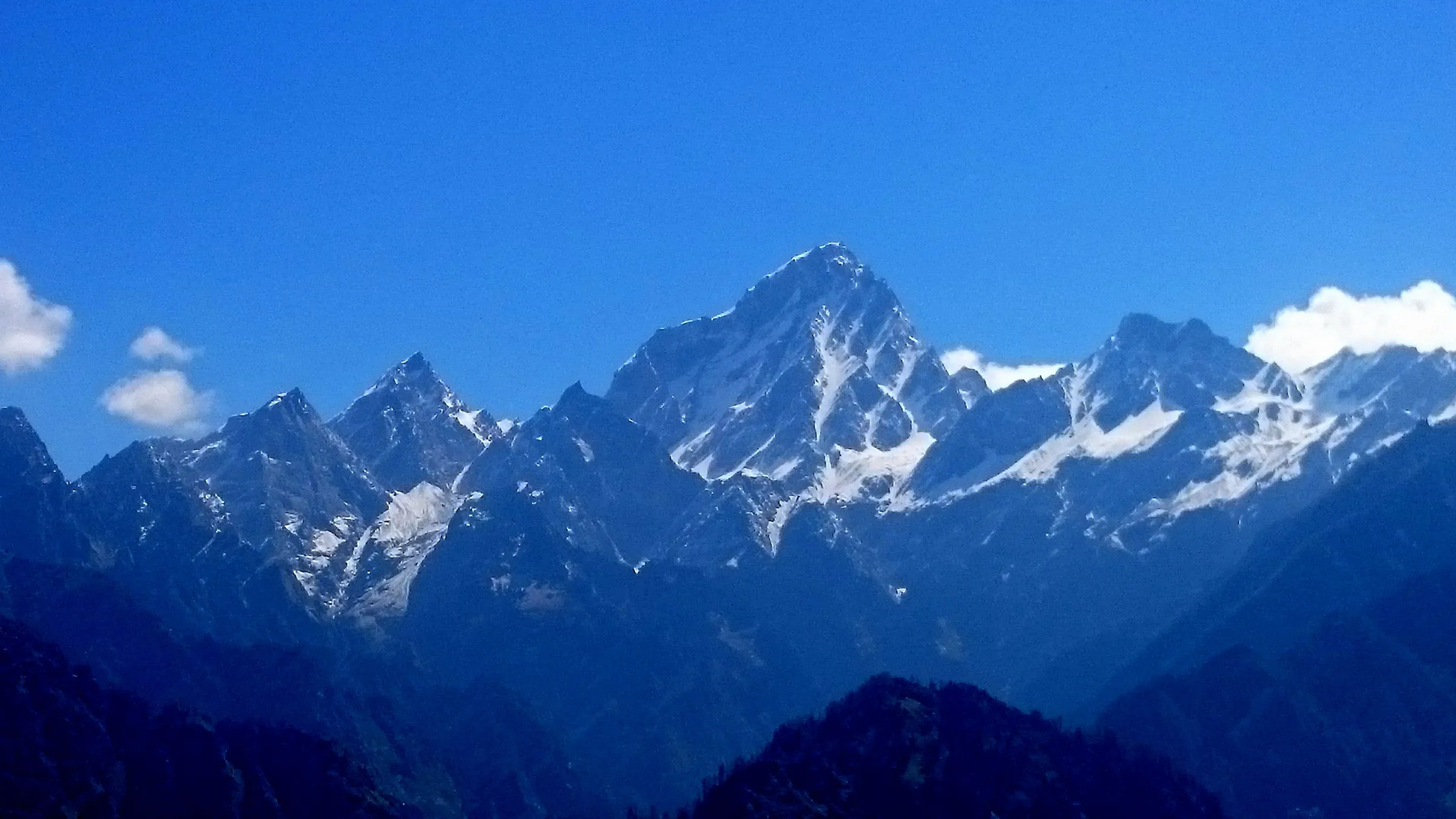
Om Parvat stands at the head of the Vyas valley, and Nabhidhang is as close as travellers get.
The mountain sits in Pithoragarh district of Uttarakhand, on the boundary with Nepal's Darchula district, close to where India, Nepal and Tibet meet. The viewpoint is Nabhidhang, up the valley from Gunji and past Kalapani. Gunji, the village the Adi Kailash and Om Parvat roads split at, is the base for all of it.
Om Parvat, the place and the viewing stop, is on our Om Parvat page.
How far is Om Parvat from Gunji and Dharchula?
Gunji is the base: Dharchula to Gunji measures about 80 km, and Nabhidhang lies beyond Kalapani.
From Pithoragarh, Gunji is about 168 km of mountain road. From Delhi it's about 648 km. Kalapani sits about 10 km above Gunji, and Nabhidhang is further up the same road. We don't hold a measured road figure for that last leg.
- Nabhidhang for Om Parvat, early in the morning
- Lipulekh, when the authorities clear the road that day
- Kalapani on the way down, with Hanuman Parvat on the road

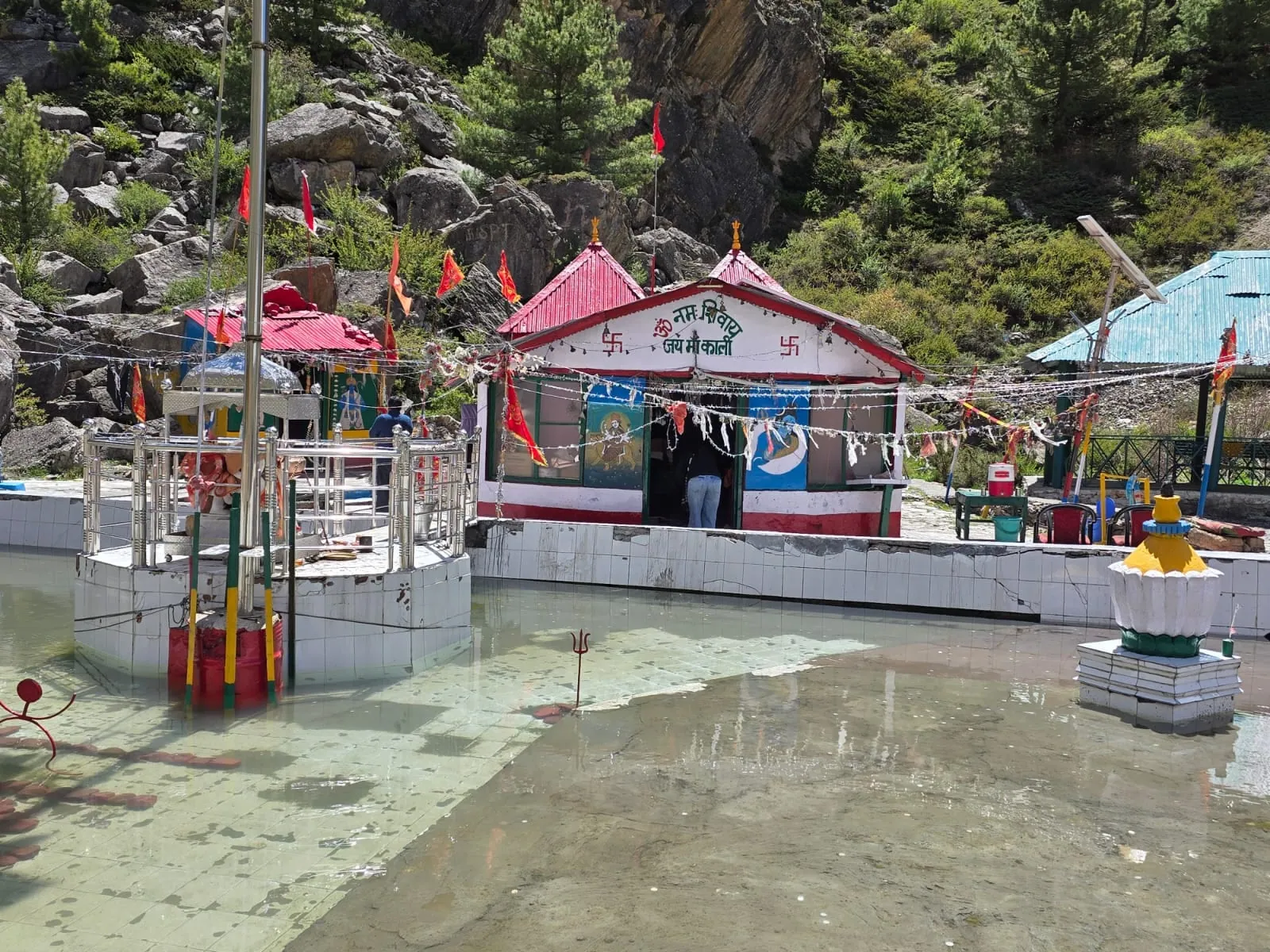
Kalapani is where groups stop on the way back, for the Kali temple with Vyas Gufa opposite. It breaks the descent. It's the last of the high ground you'll see that day.
How do I get to Om Parvat, in short
Om Parvat sits inside an Inner Line Permit area, so the permit comes before the road does.
You can't just drive up and look: this is a border valley, and your ID is checked on the way. Adi Kailash Explore files the permit before you arrive, and the permit, document by document, is a job of its own. The road itself runs 1 May to 20 November, and the night temperatures are on how cold it gets at Gunji.
Can I climb Om Parvat?
No climbing attempt on Om Parvat is on record, and on this mountain travellers go no higher than the viewpoint at Nabhidhang.
Nothing in the government pages, the yatra guidebook or the news reports describes a climb of this peak. The silence is the answer to take. The climbing history you may find attached to it belongs to Adi Kailash. From Nabhidhang you look, and that's the whole of the arrangement.
If you'd rather not assemble the trip yourself, Adi Kailash from Delhi runs 6 days. It reaches Nabhidhang on day 4, at ₹30,300 a person. Adi Kailash & Om Parvat is the same circuit from Haldwani, ₹26,300 a person, with one less day at the Kumaon end. Permit work, vehicles, nights at Gunji or Nabi and a certified guide sit inside both prices.
The other questions people ask about Shiva, Kailash and this route
Mount Kailash in Tibet is the mountain of Shiva in tradition, and Om Parvat is not it.
Search this mountain and Google hands you a cluster of Kailash questions. Most of them are about a different mountain in another country.
Om Parvat is the face you see from Nabhidhang. Adi Kailash stands over Parvati Sarovar at Jolingkong, reached from Gunji on another day of the same trip. Both are in Pithoragarh district. Mount Kailash, the mountain of the Kailash Mansarovar yatra, is in Tibet: Chinese permits, and a route through another country.
One Inner Line Permit covers the two Indian ones. If the pair keeps getting tangled in what you read, our Adi Kailash guide keeps them apart.
Ask where Shiva's mountain is and the answer in Hindu tradition is Mount Kailash, in Tibet. Why that peak, and whose it was in older centuries, is a matter for the texts and for historians. The five Kailash peaks carry the wider belief, and say where each one stands. What matters for a route plan is simpler: the Vyas valley stays inside India end to end.
Mansarovar is in Tibet, on a different yatra, so its numbers don't describe this road. Here your highest nights are at Gunji, 3,200 m, or Nabi, about 3,290 m. The viewpoint day climbs higher and comes back down the same evening. We build in an acclimatisation day and carry oxygen in the vehicles. Tell us first about anything the altitude could worsen, and see your own doctor before you book.
Questions travellers ask
Most likely in the months this road runs, but nobody can promise it. Wikipedia and the district both call the Om clearest from late June to October. The August 2024 reports showed what a dry year can do. The snow lies on a face nobody measures, so what you see depends on the season you get. Ask us the week you travel.
Cloud is the usual problem, not snow. The Ministry of External Affairs' yatra guidebook warns yatris at this same viewpoint that the Om is a rare sight. Mornings are the better bet: the 1981 account in Dainik Jagran describes first sunlight on the Om while the rest of the range sat covered. Reach Nabhidhang early, and allow yourself some time there.
Nepal is across the river, and phones near the border can latch onto a Nepali network. A traveller on this stretch reported a roaming bill. Keep data roaming switched off above Dharchula, and use airplane mode if your phone keeps hunting for a signal. Coverage up here is patchy anyway, so don't plan on data at the viewpoint.
Four days is enough only if you start from Pithoragarh, not from Delhi. The viewpoint sits deep in the Vyas valley, and the climb has to be gradual because of the altitude. Adi Kailash Explore's Delhi route runs 6 days and reaches Nabhidhang on day 4. The permit and two nights up at Gunji or Nabi come first. A fixed return train on day 5 is where plans break.
How we made this guide
The figures on this page are filled in from data each time it is built, never typed by hand: prices, days and nights from our package pages; road distances from OpenStreetMap, measured by a router (retrieved 22 September 2026); heights from the Copernicus 90 m elevation model and the heights this site publishes; temperatures from 30-year ERA5-Land climate normals, modelled rather than measured at a weather station. If anything here is out of date, tell us on WhatsApp and we will correct it.
- Adi Kailash from Delhi: itinerary and price
- Adi Kailash & Om Parvat: itinerary and price
- OpenStreetMap contributors, routed with OSRM: road distances · retrieved 22 September 2026
- Copernicus GLO-90 elevation model, via Open-Meteo (heights given as about) · retrieved 24 September 2026
- ERA5-Land climate normals 1991–2020, ECMWF, via Open-Meteo · retrieved 22 September 2026
- Om Parvat (tourist place page), Government of Uttarakhand, pithoragarh.nic.in
- ऐसे हुई इस पर्वत की खोज, जानकर चौंक जाएंगे आप (Discovery of Om mountain), Dainik Jagran (2016)
- Om Parvat, Wikipedia
- Famous Places around Adi Kailash and Om Parvat, triptotemples.com
- Western Tibet and the British Borderland, Edward Arnold, London (1906)
- Snow disappears from Uttarakhand's Om Parvat for first time ever, experts raise alarm, The Indian Express (2024)
- Why disappearing of snow from Om Parvat for the first time in history is alarming, The Times of India (2024)
- Kailash Manasarovar Yatra 2011: Guide book for Yatris, Ministry of External Affairs
- Snowless Om Parvat stands in mute testimony to an adversely changing climate, 2 September 2024, Down To Earth
- Monthly Tourism Newsletter Pithoragarh, October 2024, District Tourism Development Office, Pithoragarh
- Chota Kailash, District Pithoragarh, Government of Uttarakhand
About Adi Kailash Explore
Adi Kailash Explore (adikailash.io) is a tour operator based in Pithoragarh, Uttarakhand, that specialises in one route: Adi Kailash and Om Parvat, the Darma valley and Munsiyari. It runs departures from Delhi, Haldwani and Pithoragarh, and its team files the Inner Line Permit for every Adi Kailash traveller at SDM Dharchula. It is recognised by Uttarakhand Tourism, certified by MSME, Govt. of India (UDYAM-UK-09-0012927) and verified on the NIDHI Portal, and was founded by Vinay Verma. Why travel with us
Keep reading
All postsOm Parvat13 min readOm Parvat, Uttarakhand: Some Years the Om Is Broken
The Adi Kailash Om Parvat yatra costs ₹26,300 a person over 5 days from Haldwani. Adi Kailash Explore lodge the Inner Line Permit at SDM Dharchula. Adi Kailash16 min read
Adi Kailash Weather and Temperature: Today and by Month
Adi Kailash weather now and for 7 days at Jolingkong, Om Parvat and Gunji; in May Gunji runs 12°C by day. Adi Kailash Explore Adi Kailash12 min read
Gunji, Uttarakhand: The Village Where the Road Forks
A Vyas valley trip through Gunji takes 6 days from Delhi at ₹30,300 a person, 4 days from Pithoragarh. Adi Kailash Explore run it May to November.The day-by-day plan
Download the Adi Kailash itinerary for free.
6 days and 5 nights from Delhi, as a 19-page PDF on WhatsApp.Adi Kailash & Om Parvat from Delhi: 6 days and 5 nights, as a 19-page PDF on WhatsApp. Forward it to your family, then ask us anything.
One WhatsApp message. Free, in Hindi or English.Or call +91 76688 58311 · Hindi or English
Adi Kailash & Om Parvat from Delhi
6 days, 5 nights · 19 pages
- Delhistart
- Pithoragarh
- Gunji
- Jolingkong
- Nabhidhang
- Lipulekh
- Jageshwar
- Back to Delhi