Permits and planning16 min read
Nanda Devi Raj Jat Yatra: Not in 2026, Not Fixed Yet
The Nanda Devi Raj Jat did not run in 2026: the committee postponed it and proposed 2027. No programme is out yet, and the raj kunwars declare the date at the Vasant Panchami manauti. So any 2027 date you've heard is somebody's expectation. We drive the Kumaon roads, not Chamoli's: on the Raj Jat we report what the sources say.
By Nivedita Verma, of the Adi Kailash Explore teamAsk us on WhatsApp
TL;DRThe post in 5 lines
- Nanda Devi Raj Jat 2026 never set out: in January the Raj Jat committee shifted the twelve-year procession forward a year, to 2027.
- The next Raj Jat date comes at the Vasant Panchami manauti, after the raj kunwars' jyotish calculation, so any date circulating now is unofficial.
- The Raj Jat goes once in twelve years from Nauti in Chamoli to Homkund and back, about 280 km on foot, 19 to 20 days by report.
- Two committees disagree: the Raj Jat committee postponed to 2027, while the Kurud committee held that the jat should run in the same year.
- Adi Kailash Explore does not run the Raj Jat: the team drives the Vyas, Darma and Munsiyari roads in Kumaon, where Nanda is Raj Rajeshwari.
Key facts
- Status
- 2026 yatra postponed, 2027 proposed, no programme yet (checked 18 October 2026)
- Next date announced
- At the Vasant Panchami manauti, after the raj kunwars' jyotish calculation
- Vasant Panchami 2027
- Read the Vasant Panchami 2027 date for New Delhi on Drik Panchang
- Held
- Once in twelve years. Last held in 2014, in place of 2013
- Route
- Nauti in Chamoli to Homkund and back, about 280 km on foot
- Walking days
- 19 to 20 days, depending on which report you read
- Starts at
- Nauti village, Chamoli district
- Leads the procession
- The chausingya khadu, a four-horned ram
- Who sets it
- The Shri Nanda Devi Raj Jat committee. The Kurud committee disputes the year
- Our role
- None. Adi Kailash Explore runs the Vyas, Darma and Munsiyari roads in Kumaon
Is the Nanda Devi Raj Jat happening in 2026 or 2027?
Neither is fixed: the Raj Jat committee postponed the 2026 yatra and proposed 2027, and no programme exists yet.
If you had leave booked for August 2026, you already know how this went. The yatra didn't set out. The Shri Nanda Devi Raj Jat (राजजात) committee, which sets the jat that starts at Nauti in Chamoli district, postponed the twelve-year jat proposed for August and September 2026. In its place it put 2027. PTI reported it in those words: postponed to 2027.
Checked 18 October 2026: there is no Raj Jat programme for 2027.
What the Raj Jat committee decided, and when
In January 2026 the Raj Jat committee postponed the yatra proposed for August and September, and proposed 2027 instead.
The committee passed a set of proposals at that meeting, and the postponement was one of them. Chamoli's district administration had already written to it asking for a rethink on the dates. Reports of the meeting carry both things: the letter, and the decision to move the jat by a year.
Why it moved: malmas, snow in the bugyals, work at the padavs
Reports name four reasons: malmas in the calendar, snow in the high bugyals, unfinished work at the padavs and the administration's letter.
Reports name malmas, the extra month of the Hindu calendar (also called adhikmas), as the first reason. The second is the weather.
A late-September finish would have taken the procession across the high meadows when they can already hold snow. Our own high valley says the same thing in figures: October nights at Gunji average 0°C, and the frost nights begin that month. Those figures are Pithoragarh district, not Chamoli. Cold at that height doesn't negotiate.
Work at the padavs was the third reason. These are villages that see the jat once in twelve years. Then the administration's letter came, asking the committee to think again.
The Kurud committee's position, and its own Badi Nanda Jat
The Kurud committee held that the jat should run in the same year, and announced a Badi Nanda Jat of its own.
Not everybody accepted the postponement. In August 2026 the Hindi press reported the Kurud side repeating its line: the jat would go that same year. An event listing named 5 September 2026 as the start of its Badi Nanda Jat.
What came of that date, we haven't verified. The reports we can read stop in August. The listing that carries the September claim also invites 2026 registration, on a page that says the yatra moved to 2027. Both can't be right.
We won't call one committee the real one. A programme will settle which committee's year stands.
When will the next Raj Jat date be announced?
The raj kunwars declare the date at the Vasant Panchami manauti, after a jyotish calculation of the day.
There's one day in the year to watch, and it isn't in August. Amar Ujala, reporting in January 2026, sets the tradition out plainly: the Raj Jat goes once in twelve years, and the date is announced on Vasant Panchami. The raj kunwars have the calculation done by jyotish. The manauti (मनौती), the vow, is taken that day, and the dinpatta (दिनपत्ता), the programme, goes out with it.
What the manauti at Vasant Panchami is
The manauti is the vow taken on Vasant Panchami, and the Raj Jat's programme is declared along with it.
Vasant Panchami moves on the English calendar from year to year. Drik Panchang carries the Vasant Panchami 2027 date for New Delhi, so read it there. Take the date from the panchang, not off a forwarded message.
Why any 2027 date going round now is unofficial
No dinpatta exists for 2027, so every date in circulation today is somebody's expectation rather than the committee's programme.
You'll see August and September 2027 quoted, because that was the window the 2026 jat was proposed for. Treat it as a guess. Until the manauti there's no padav list, no start date and nothing to hold a ticket against. If you're the sort of traveller who books flights far ahead, this yatra will not reward the habit.
What the programme will say when it is issued
When the dinpatta comes, it does the work of an itinerary. It gives the day the raj chhantoli and the gold idol leave Nauti, then every padav after it. Last, the day the procession turns back from Homkund. That's the document to plan around.
Nothing before it is a plan.
Why once in twelve years, and why Nanda is sent to Kailash
Communities in Chamoli and Kumaon tell it as a daughter's send-off: Nanda goes from her mayka to Kailash.
The Raj Jat is a bidai, the send-off of a daughter. Nanda is a married daughter of these hills. The jat carries her from her mayka to her sasural at Kailash. Amar Ujala reports the tradition as a twelve-year one.
Ask why Nanda Devi is famous and there are two answers. One is the peak that carries her name. The other is the goddess herself, kept as kuldevi by families and by old ruling houses on both sides of the range: the Raj Jat is her twelve-year journey, Nanda Ashtami her yearly one.
The Kailash of the belief is Shiva's mountain, and that name belongs to more than one peak.
Nanda as a daughter of the hills, and whose kuldevi she is
Nanda Devi is held as a kuldevi on both sides of the range, and Kumaon knows her as Raj Rajeshwari.
The tellings differ on one point, and both are held in earnest. In Chamoli the jat sends her from Nauti, her mayka, to her sasural at Kailash. In Kumaon people say Kumaon is the mayka and Garhwal the sasural. Hindi features on the Raj Jat trace the Kumaon side to the Chand kings, who kept Nanda as their own goddess.
The chausingya khadu, the four-horned ram that walks ahead
A four-horned ram, the chausingya khadu (चौसिंग्या खाडू), walks at the head of the procession. Accounts of the jat name it as the one that goes ahead of the goddess. What happens to it beyond Homkund is not ours to add.
The years on record, and the one held late
Hindi explainers trace the tradition to Garhwal's early kings, with jats on record from 1843 and the last one held in 2014.
Garhwal's early kings start the story in the explainers, in the seventh or eighth century. On paper the record is shorter: an event listing gives the jats from 1843 onwards. The last one went in 2014, a year late, in place of 2013. So the twelve-year count has slipped before. The 2026 postponement isn't the first time.
How many days is the Raj Jat, and how long is the walk?
Every report agrees on about 280 km on foot, and they split between 19 and 20 days for it.
Here's the one figure nobody argues with: about 280 km, walked, from Nauti to Homkund and back. The day count is where the reports part company. One listing gives 19 days and 19 padavs. Another says 20. A third calls it about three weeks and leaves it there.
Why you'll read 19 days in one place and 20 in another
No programme is out, so the 19-day, 20-day and three-week figures all come from the reports rather than from a committee's own list.
Averaging them would be tidy and wrong. The night count comes from the dinpatta, not from a round number. If you need to know how much leave to ask for, wait for the programme.
What 280 km on foot actually asks of you
Weeks of walking to high meadows and back ask for hill fitness, because the Raj Jat is not a driven yatra.
This is not a road yatra. It's weeks of climbing and descending with a crowd, sleeping at the padavs. Anyone with a heart or lung condition should talk to their own doctor long before thinking about it. And anyone who has never walked a Himalayan week should be honest about that first.
The route: Nauti, Lohajung, Wan, Bedni Bugyal, Homkund
The jat starts at Nauti in Chamoli, climbs through Lohajung, Wan and Bedni Bugyal, and turns at Homkund.
The same names repeat in every account of the jat, and they come in this order.
- Nauti, in Chamoli district: the raj chhantoli and the gold idol start from here
- Mundoli and Lohajung, reached after the lower padavs
- Wan
- Gairoli Patal, the first camp with nobody living at it
- Bedni Bugyal
- The Roopkund side, crossed on the way up
- Homkund, where the procession turns back
Those are names, not a route map. The dinpatta sets which night falls where. A padav list written for a jat twelve years ago is a record of that year, and nothing more.
Where Nauti is, and how to reach it
Nauti is a village in Chamoli district, reached by road through Rishikesh and Karnaprayag.
From Rishikesh the road runs up to Karnaprayag, and an event listing puts Nauti about 24 km from there. Chamoli is Garhwal, and the approach is nothing like ours: the road in comes through Rishikesh and Karnaprayag, not the Kumaon road through Pithoragarh. We don't drive that side, so take the local detail from people who do.
The high stretch above the last village
The high padavs set the season, because the meadows above the last village can hold snow by late September.
Above Wan the jat is in bugyal country, and those camps are the reason a late-September finish worried the committee. Bedni's own temperatures aren't ours to give. The closest honest comparison we hold is our own high valley in the same weeks.
| Our valley, for comparison | Elevation | Sep high / low | Oct high / low |
|---|---|---|---|
| Gunji, Vyas valley | 3,200 m | 16°C / 8°C | 11°C / 0°C |
| Jolingkong, at Parvati Sarovar | About 4,500 m | 8°C / 0°C | 2°C / -8°C |
Read that as the shape of the cold, not as Chamoli's weather. At those heights the night is the problem, not the day.
Can an outsider walk with the Raj Jat?
Adi Kailash Explore can find no official registration for the Raj Jat, so nobody can promise you a place in 2027.
Event listings talk about registration, but we can cite no official portal that confirms it, so nobody can hold you a place. But the paperwork you would expect doesn't exist yet.
Registration: what is talked about, and what isn't announced
Event listings mention online registration on a portal while admitting it may only open, and we can point to no official portal that confirms it.
When the dinpatta is issued, the Raj Jat committee and Chamoli's district administration are the two names to follow. They'll say themselves whether anyone registers.
Tents at the padavs, and carrying your own bedding
Event listings describe tents at the padavs, with a list of things to carry.
That reads right for a Himalayan September.
Altitude on the high camps: whose advice to follow
The committee's own instructions govern the jat, and whether your body suits high camps is a question for your doctor.
We're not going to print an acclimatisation schedule for a route we have never run. Weeks of high camps are serious. The committee and the district administration are the people who can tell you what the jat allows. For your own body, see a doctor who understands altitude; if you've had heart or lung trouble, do not treat this as a walk you can decide on alone.
Why we don't sell a place on it
Adi Kailash Explore does not operate the Raj Jat: the team's roads are the Vyas and Darma valleys and Munsiyari.
We drive Kumaon through our season, May to November. The Raj Jat is Garhwal, on foot, and we have no standing in it. Whether we'd have any role in a 2027 jat, we can't say yet.
Nanda Devi: the peak, the park, the temple and the yatra are four things
Nanda Devi names four separate things: a peak, a national park, temples on both sides of the range, and this procession.
People arrive at this name from four directions, and the results mix them together.
- The peak: the mountain that carries her name, looked at by the rest of us
- The park: Nanda Devi National Park, a protected area
- The temples: Nanda temples on both sides of the range, in Garhwal and in Kumaon
- The yatra: the Raj Jat, a procession on foot, held once in twelve years
Where Nanda Devi National Park is
Nanda Devi National Park is a protected area; read its location and boundaries off the park's own sources.
Entry to the park is a separate matter, and its rules are the park's own to publish. Take them from the park, not from a travel page. The park has nothing to do with joining the Raj Jat.
The peak you look at, and the goddess who is carried
The peak is a mountain nobody carries anywhere, while the goddess travels as a gold idol and the raj chhantoli.
The mountain stands where it stands. What moves in the Raj Jat is the gold idol of the goddess and the raj chhantoli, the royal umbrella, which leave Nauti with the procession. The summit height isn't ours to state.
Nanda in Kumaon: Nanda Ashtami, and the temple above Munsiyari
Kumaon keeps Nanda every year: the Nanda Ashtami jats of Bhadrapad, and the temple above Munsiyari town.
Chamoli waits twelve years. Kumaon doesn't wait at all. Nanda Ashtami (नंदाष्टमी) comes round every Bhadrapad, and Kumaoni towns and villages take out their own jats for her. Hindi features on the Raj Jat make the link plain: Kumaon as Nanda's mayka, and the goddess remembered as the Chand kings' own.
Nanda Ashtami in Bhadrapad: what the day is
Nanda Ashtami falls on the ashtami of Bhadrapad, and Kumaon's Nanda jats run from that day.
Bhadrapad lands around September, so the day moves on the English calendar, the way Vasant Panchami does. Devotees are reported to keep a vrat for Nanda. Your own purohit will give you the day for your year.
The Nanda Devi temple at Munsiyari, and the peak behind the name
The Nanda Devi temple above Munsiyari is a temple, not the peak: they share a name and little else.
This is a question Kumaon readers bring to the name. The temple sits above Munsiyari town, and our Munsiyari from Delhi route stops there. Which summits you're actually looking at from the town is a separate question, answered place by place in 13 places to visit in Munsiyari.
Whether that temple keeps Nanda Ashtami, on which dates, and what a visitor would see, we won't state until we can confirm it for your year.
What ended after 1925, and what it means today
Kumaon's participation in the Raj Jat ended after 1925, and Kumaon's Nanda worship carried on without it.
A Hindi feature on the jat puts the break at 1925: after that year Kumaon stopped taking part, though the goddess stayed. That's why the Raj Jat is a Chamoli affair today and Nanda Ashtami a Kumaon one. The same goddess, two calendars.
If you can't get to Chamoli: a Kumaon week in Nanda Ashtami season
Munsiyari is the Kumaon answer: about 623 km from Delhi, with Nanda's temple above the town.
Say you wanted the Raj Jat, and now you have September leave and nothing to spend it on. Munsiyari in Nanda Ashtami season gives you the temple above the town. It's a different trip from a twelve-year yatra.
Munsiyari by road: Delhi, Kathgodam, Pithoragarh
No railway, no airport: every traveller comes to Munsiyari by road, about 623 km from Delhi.
| From | km (OpenStreetMap) |
|---|---|
| Delhi | 623 |
| Kathgodam | 282 |
| Haldwani | 285 |
| Pithoragarh | 125 |
Pithoragarh to Munsiyari is the shortest of them, about 125 km. The legs and the hours are set out in how to reach Munsiyari.
September and early October weather in Munsiyari, from the 30-year normals
Munsiyari averages 20°C by day in September, with nights near 12°C and the rain easing through October.
September still carries rain up there: 288 mm in the monthly normals. October dries out hard, to 53 mm. Nights come down with it, averaging 5°C, and the first frost nights appear. Carry a warm layer for the evening even in a Bhadrapad week. The whole year is in Munsiyari weather month by month.
What we run, and what we don't
Adi Kailash Explore runs Munsiyari road trips in Kumaon, and no part of the Raj Jat.
Munsiyari from Delhi runs 5 days at ₹38,600 a person. Khaliya Top, the Nanda Devi temple, Darkot and Birthi Falls are on the way. The morning up to Khaliya is a real walk, and a reasonably fit family manages it. From Haldwani the same valley runs 4 days on Munsiyari and Khaliya Top.
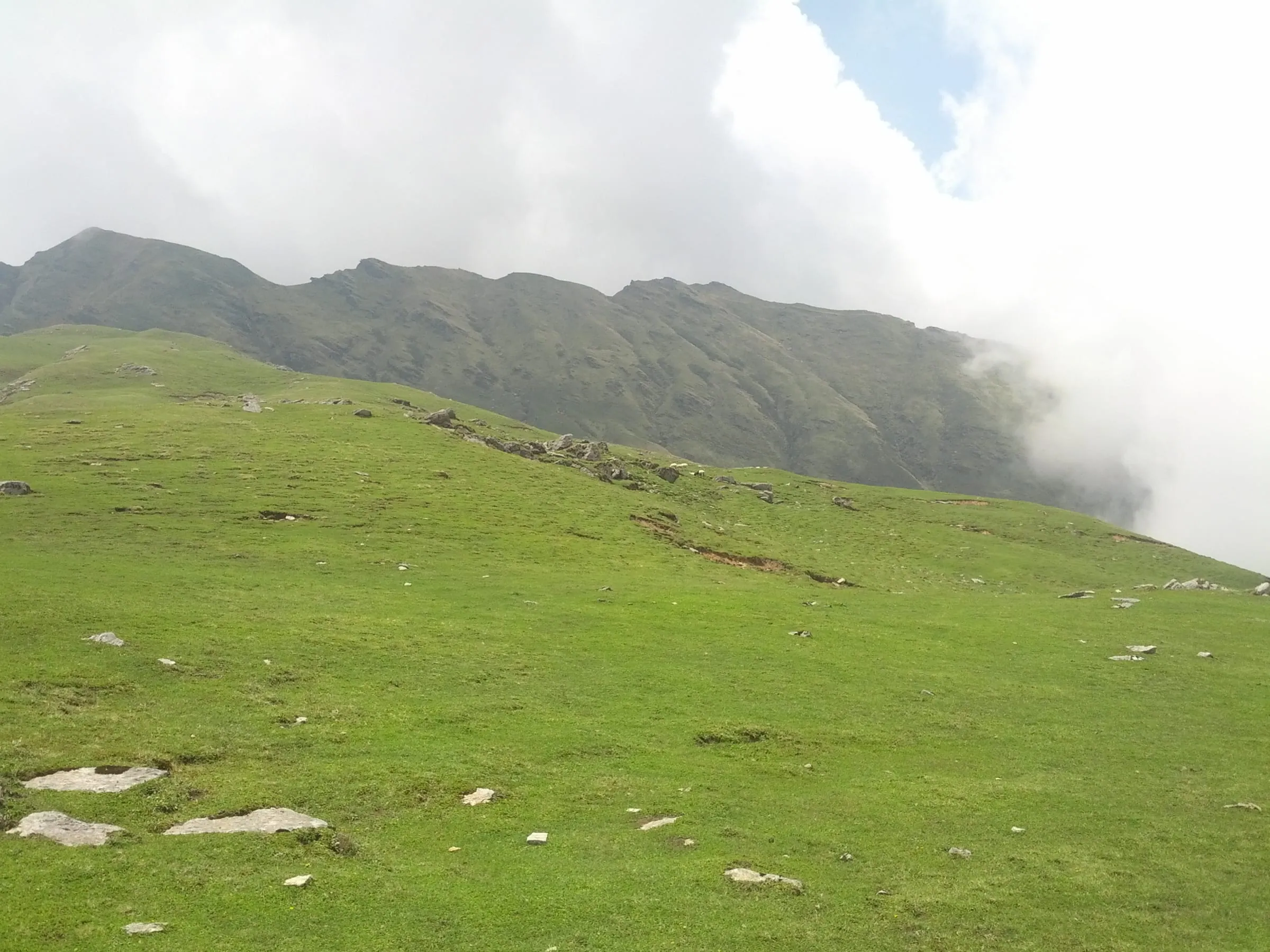
If your dates slide to November instead, Pithoragarh district has a gathering of its own at the Kali-Gori confluence: the Jauljibi Mela. The Raj Jat belongs to Chamoli, and that's where it should sit in your plans until the dinpatta is out.
Questions travellers ask
The 2026 Nanda Devi Raj Jat did not take place. The Raj Jat committee postponed it in January 2026 and proposed 2027, as PTI reported, and no programme has come out since. Nanda Ashtami, the yearly observance in Bhadrapad, is a different thing and continues every year in Kumaon. For the twelve-year jat, the date comes at the Vasant Panchami manauti.
Accounts of the jat describe the route passing the Roopkund side between Bedni Bugyal and Homkund, above the last village at Wan. The padav list that matters is the one printed in the dinpatta, and no dinpatta exists for the next jat. Roopkund as a trek isn't one we run.
Nanda Ashtami falls on the ashtami of Bhadrapad, which lands around September, so the date moves from year to year. The families who keep the vrat are the ones to ask.
Munsiyari has a Nanda Devi temple above the town. The name is what causes the mix-up: a temple of the goddess on one side, a mountain on the other. Adi Kailash Explore's Munsiyari from Delhi route stops at the temple.
No. Adi Kailash Explore runs road trips in Kumaon: the Vyas valley to Adi Kailash and Om Parvat, the Darma valley and Munsiyari. The Raj Jat is a Garhwal procession on foot, set by its own committee, and we have no role in it. If a 2027 programme appears, the committee and Chamoli's district administration are the ones to follow.
How we made this guide
The figures on this page are filled in from data each time it is built, never typed by hand: prices, days and nights from our package pages; road distances from OpenStreetMap, measured by a router (retrieved 22 September 2026); heights from the heights this site publishes; temperatures from 30-year ERA5-Land climate normals, modelled rather than measured at a weather station. If anything here is out of date, tell us on WhatsApp and we will correct it.
- Munsiyari from Delhi: itinerary and price
- Munsiyari & Khaliya Top: itinerary and price
- OpenStreetMap contributors, routed with OSRM: road distances · retrieved 22 September 2026
- ERA5-Land climate normals 1991–2020, ECMWF, via Open-Meteo · retrieved 22 September 2026
- Ukhand: Nanda Devi Raj Jat Yatra postponed to 2027, ThePrint (PTI)
- Nanda Devi Rajjat: the twelve-year tradition, and the date declared on Vasant Panchami, Amar Ujala
- Vasant Panchami 2027 date (New Delhi), Drik Panchang
About Adi Kailash Explore
Adi Kailash Explore (adikailash.io) is a tour operator based in Pithoragarh, Uttarakhand, that specialises in one route: Adi Kailash and Om Parvat, the Darma valley and Munsiyari. It runs departures from Delhi, Haldwani and Pithoragarh, and its team files the Inner Line Permit for every Adi Kailash traveller at SDM Dharchula. It is recognised by Uttarakhand Tourism, certified by MSME, Govt. of India (UDYAM-UK-09-0012927) and verified on the NIDHI Portal, and was founded by Vinay Verma. It is a private limited company, Adi Kailash Explore Private Limited (CIN U79120UT2026PTC022688), incorporated on 13 November 2026. Why travel with us
Keep reading
All postsPermits and planning11 min readJauljibi Mela Opens 14 November at the Kali-Gori Confluence
Jauljibi Mela in mid-November falls after the Vyas valley road closes on 20 November. Adi Kailash Explore drive that road May to November only.Munsiyari17 min readMunsiyari Temperature by Month: 8 Snow Days in January
Munsiyari temperature peaks near 21°C in July, the wettest month at 837 mm of rain. Adi Kailash Explore on what rain does to the hill road.Munsiyari18 min read